
The History of Skies of Arcadia
Skies of Arcadia (Dreamcast, 2000), Eternal Arcadia in Japan, is Overworks' RPG of airship exploration in a world of floating islands under six moons. It was produced by Rieko Kodama, the Phantasy Star veteran who had directed Magic Knight Rayearth on the Saturn shelf of this Library, and it stands as the Dreamcast's defining traditional RPG: a 93 on Metacritic, and a commercial disappointment in every version ever released.
THE MAKING
Overworks, begun on the SaturnDevelopment began in 1999 under the name Project Ares, and it began on the Saturn: the early design put its battles on land and on train tops. Moving to the Dreamcast fixed the concept in the sky. The team of about twenty was drawn from Team Andromeda and the Phantasy Star staff, and its leads were directors Atsushi Seimiya and Shuntaro Tanaka, who also wrote the scenario. Tanaka, a history major who had written the stories of Sakura Wars and Sakura Wars 2, built the world on the Age of Discovery, by the developers' own account (Tier 1): an age when maps had edges and every horizon was a rumor.
The tone was deliberate counter programming. Against the dark, complicated RPGs of the Final Fantasy VII and VIII era, Skies was designed bright, cheerful, and simple in spirit; towns were built seamless, interiors entered without loading; and Aika and Fina were written as equals of Vyse, not rescue targets. Composers Yutaka Minobe and Tatsuyuki Maeda scored it. The localization, by Chris Lucich (Panzer Dragoon Saga's localizer) and Klayton Vorlick, ran four months at eighty to one hundred hour weeks against a script of more than 2,000 pages, largely rewriting the dialogue, with edits that turned alcohol into Loqua juice and removed cigarettes.
THE DESIGN
Discovery as the systemThe game's signature mechanic is the Discovery: the world map hides wonders, ruins, and strange phenomena that are not marked, only rumored, and finding and reporting them is a progression system of its own. Tanaka's concept makes exploration the reward loop rather than the travel between rewards. Around it sit turn based party battles, ship to ship cannon duels fought like duels of position and nerve, and a guild's worth of optional hunts and charts. It plays, deliberately, like the optimistic inverse of its era's flagship RPGs.
THE EDITIONS
Two names, two paintingsEternal in Japan, Skies in the West
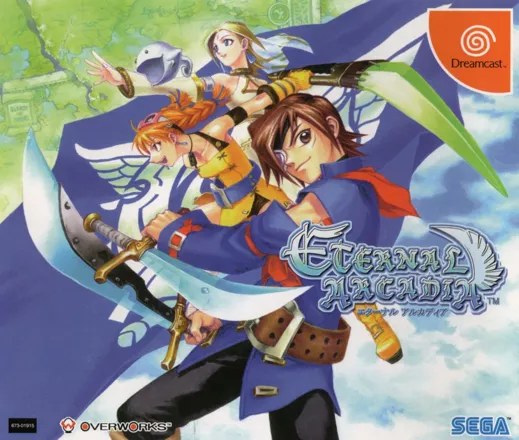
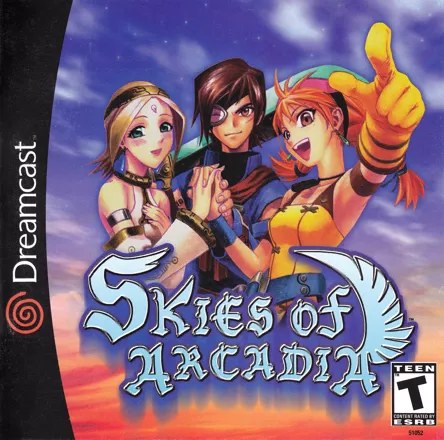
Europe followed on April 27, 2001. The Dreamcast original spans two GD-ROMs.
THE RECEPTION
93, and the one complaint inside itThe dissent is unusually specific and unusually consistent: the random encounter rate. Critics raised it inside glowing reviews, on the Dreamcast in 2000 and again, as the thing the GameCube edition most needed to fix, on Legends in 2003, where it duly was reduced. Edge praised the game in terms that made the reservation smaller still. There is no strong negative review of Skies of Arcadia on the record; there is a near unanimous great review with a footnote, and the footnote is about how often the sky interrupts you.
THE LEGACY
Beloved, unsold, unportedThe game entered 1001 Video Games You Must Play Before You Die, and its cast crossed into Valkyria Chronicles, also directed by Tanaka. Tim Schafer has said on the record (Tier 1) that Skies of Arcadia and Rayman 2 were the main influences on Psychonauts. And yet neither version sold well, no official figures have ever been published, the planned sequel was shelved by December 2004, and the game has had no rerelease since 2003. Skies of Arcadia is the Dreamcast shelf's purest specimen of scarcity by neglect: nothing about it failed except the selling, and everything else about it has been compounding since.