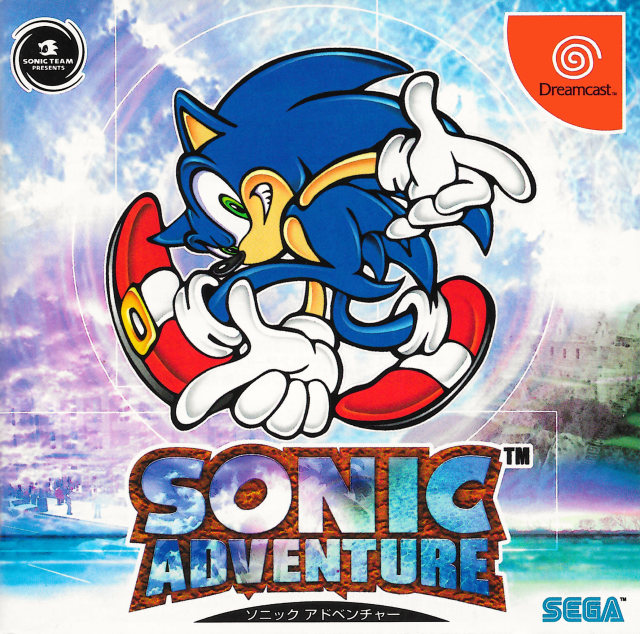
The History of Sonic Adventure
Sonic Adventure was the first main Sonic game in full 3D, developed by Sonic Team for the Dreamcast and released in Japan on December 23, 1998, then worldwide as the centrepiece of the Dreamcast launch on September 9, 1999. It redesigned every character, gave the cast voices, sent its designers to Peru and Guatemala for its ruins, and became the best selling Dreamcast game at 2.5 million copies.
THE MAKING
After X-treme, a ten month sprintSonic's first attempt at 3D, the Saturn's Sonic X-treme, had been cancelled, and Sonic Team began again in 1997 under director Takashi Iizuka and producer Yuji Naka. The team grew to around sixty and built the game in roughly ten months, beginning on the classic Genesis designs and discovering quickly that they failed in 3D: bodies too short, heads too big, characters hard to read from behind and above, where a 3D camera spends its life.
The world was researched on the ground. Sonic Team travelled to Peru and Guatemala and drew the game's ancient ruins, jungles and lost civilisations from what they found there, while the human city of Station Square gave the series its first realistic setting. The structure was new in kind: six playable characters, Sonic, Tails, Knuckles, Amy, and newcomers Big the Cat and E-102 Gamma, each with a campaign interlocking around the water god Chaos, hub adventure fields between the action stages, full voice acting, and the Chao garden, a virtual pet living inside the action game.
The sound changed with the dimension. Lead composer Jun Senoue steered the series away from the electropop of the Nakamura era toward rock, the sound the Adventure games and his band Crush 40 made the series' second musical identity.
THE REDESIGN
One Sonic, worldwide, at lastSega held an internal contest for the new look, with entries from the series' own artists, including Sonic's original designer Naoto Ohshima. Yuji Uekawa won. Looking to Walt Disney and Looney Tunes animation, he made Sonic taller and slimmer, with longer drooping quills drawn as a silhouette first, darker blue fur, and green irises, a deliberate reference to Green Hill Zone. Iizuka has said the new design suited 3D, where the compact original, drawn to be seen from the side, did not.
The redesign ended the regional split this Library documents on the covers page: from Adventure onward there is one Sonic design for the whole world, and the two hedgehogs of the 1990s boxes became a period artifact.
THE EDITIONS
Dreamcast first, then the portsTHE RECEPTION
Acclaim, with the dissent keptTHE LEGACY
The template of modern SonicAdventure set the shape the series still uses: Uekawa's designs, multiple playable characters with distinct play styles, a sung rock theme, hub worlds and Chao. It could not save its console, and Sega left hardware two years later, but as a game it did its job completely, outselling everything else on the Dreamcast and proving Sonic could headline a 3D launch. Its sequel, built by the series' new American studio, closes this shelf.