
The History of Tales of Destiny
Tales of Destiny (PlayStation, 1997) was the second main Tales game and, for a decade, the best-selling one in Japan: over a million copies worldwide by 2007, the top-selling single-platform Tales title of its time. Its heroes fight beside Swordians, sentient blades with personalities, in real-time 2D battles that Namco's American team openly worried looked ordinary, and answered by betting the release on its localization. The bet, and the game's famous sequel naming trap, are both in the record.
THE AMERICAN BOX
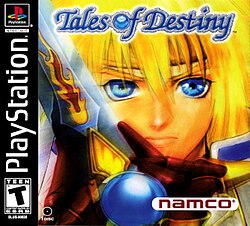
The Japanese box was not verified to the Library's standard in this pass and is a named gap. The American box's Leon-forward art was its own choice: the Swordian's wielder, not the hero Stahn, fronts the Western edition.
THE MAKING
Wolf Team, Inomata arrivesDestiny was developed by Wolf Team at Telenet Japan, directed under producer Eiji Kikuchi, with music by Motoi Sakuraba and Shinji Tamura. Its art marked a series turning point: Mutsumi Inomata, one of the best-known anime character designers of her generation, joined the series here and became one of its two defining artists. Animation studio Production I.G produced the anime cutscenes, including the opening. The game was exhibited at Tokyo Game Show in September 1997 and released that December.
The American production is documented with unusual candor. The North American producer said the 2D graphics were so ordinary that the team resolved to compensate with an outstanding localization, and Namco America set out to record a full English dub, searching for voice talent, before the plan collapsed: the released Western version keeps the Japanese voice work, making it, per the documented record, the only Tales game whose translation retains the original voices. The Japanese opening theme, Deen's Yume de Aruyouni, was replaced in the English version over licensing.
THE DESIGN
Linear Motion battles and swords that talkThe Enhanced Linear Motion Battle System keeps Tales' signature: battles play in real time on a 2D plane, the player directly controlling one fighter's movement, strikes, and artes while the party fights beside them, a fighting game's grammar inside an RPG. Destiny's addition is the Swordians: intelligent swords, Dymlos, Atwight, Igtenos, Chaltier among them, who converse, argue, and carry the plot's ancient war in their own memories, and whose growth systems shape their wielders' abilities.
Around that core it is proudly of its moment: random encounters, a world map with drawn routes, cooking, and a coliseum. Contemporary reviewers who loved it said so about the battle system and the cast; those who did not aimed at exactly the same 2D presentation Namco America had worried about, which makes Destiny one of the era's cleanest documented arguments about what graphics were for.
THE EDITIONS
The remake that never traveledTHE RECEPTION
A split written in advanceThe later verdicts softened on schedule: retrospectives credit Destiny's localization as a model for foreign 2D releases, and its remake's improved Famitsu panel suggests the game underneath the presentation was never the problem. The collector's reality is simpler: Japan got the game three times across two consoles, and the West got the 1998 disc, which is the edition this Library page and its box picture document.
THE LEGACY
The Tales formula, codifiedDestiny fixed the elements the series still runs on: Inomata's designs, Sakuraba's score, Production I.G class animation, and the Linear Motion battle grammar that every later entry extends. Its sequel confusion with Eternia remains the single most common cataloging error in the franchise, which is why the Library documents it above rather than leaving it to footnotes. The series' Super Famicom origin is in the Library's Tales of Phantasia history, linked below.