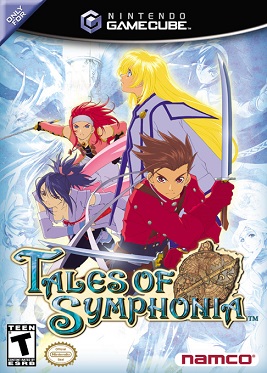
The History of Tales of Symphonia
Tales of Symphonia (GameCube, 2003) is the fifth main Tales game and the series' first in 3D. It was directed by Yoshito Higuchi, Kiyoshi Nagai and Eiji Kikuchi at Namco Tales Studio, produced by Makoto Yoshizumi, written by Takumi Miyajima, designed by Kosuke Fujishima, and scored by Motoi Sakuraba with Shinji Tamura and Takeshi Arai. It follows Lloyd Irving and the Chosen, Colette Brunel, on a pilgrimage to regenerate a dying world, and learns halfway through that saving one world starves its twin.
THE MAKING
A collaboration, announced in TokyoSymphonia began in public as a partnership. On May 8, 2002, Namco and Nintendo held a Tokyo press conference to announce they would collaborate on GameCube titles, including a new Tales game then slated for July 2003. The game was developed under the working title Tales of Phantasia before its final name was revealed in February 2003. A Famitsu report that April put the development at two years, with most of the staff carried over from Tales of Eternia, the most main characters in a Tales game to date, and the series' first step into 3D.
The Japanese launch made an event of it: the game shipped on two discs, with the theme song Starry Heavens by Day After Tomorrow, and a symphonic green GameCube bundle sold in Japan. For North America, localization producer Nao Higo replaced the theme song with an orchestral anthem by Sakuraba and cast experienced English voices, including Scott Menville, Tara Strong and Cam Clarke. The Western skits, the series' signature character conversations, shipped without the voice acting the Japanese version carried, a cut reviewers noticed.
THE DESIGN
Battles on a line, affection underneathBattles run on the Multi-Line Linear Motion Battle System: four party members fight in real time along lines toward their targets, and damage fills a Unison Gauge that can be spent on a combined Unison Attack. Around the battles sit the systems fans still cite: EX Gems that bend each character toward Strike or Technical arts, Titles that steer growth, a Grade score spent on New Game Plus bonuses, and cooking after battle. The skits do the quiet work, an affection system tracking how Lloyd's choices land with each companion, feeding a story Miyajima planned, in his own description, as a unique symphonia dependent on the player's choices.
One choice was rewritten late. Zelos Wilder's death was originally meant to be canon, governed by the affection rankings; the staff argued for Kratos Aurion's return to the party instead, and Miyajima reworked Zelos's death into a non-canon path. The shipped game keeps both doors open, which is part of why its cast is still argued about.
THE EDITIONS
Two discs, then a decade of returnsTHE RECEPTION
86, and the GameCube's best RPG, said Nintendo PowerThe dissent kept to specifics: an underwhelming overworld compared, unfavorably, to the generation before; difficulty spikes at the bosses; fetch quests; and a localization whose word choices IGN's reviewer found all over the linguistic map. Nobody's complaint was the battles.
THE LEGACY
The series' best seller, and its Western doorSymphonia sold over 100,000 copies in the United States in its first two weeks and reached 2.4 million copies worldwide across all platforms, the best selling Tales game of its time. Bandai Namco's own accounting, as of 2008, made it the best selling Tales title overseas, with more than half its sales from outside Japan: about 600,000 in North America and 250,000 in Europe. Before Symphonia, Tales was a Japanese institution with a thin Western foothold. After it, the series had a Western flagship.
The afterlife is long: a Wii sequel in 2008, seven manga collections, two novel series, seven drama CDs, and a ufotable anime that ran in three arcs from 2007 to 2012. On this shelf it stands as the GameCube era's clearest proof that the small RPG shelf was not a weak one.
THE GAME ON THE SHELF
Tales of Symphonia · GameCube