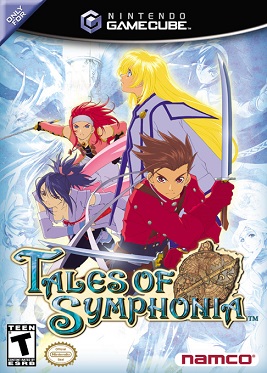
Why Did Tales of Symphonia's PlayStation 2 Port Stay in Japan?
Tales of Symphonia shipped for GameCube in Japan on August 29, 2003, and in North America and Europe in 2004. In Japan it then received what the West never did: an enhanced PlayStation 2 port, announced in April 2004 and released on September 22, 2004, with additional content and a new theme song. Western players who wanted that content waited a decade for it. Namco never explained the decision on the record, so this page separates what is documented from what is only believed.
THE DOCUMENTED RECORD
What can actually be shownThe GameCube game was a collaboration from birth. It was one of the titles announced at the May 8, 2002 Tokyo press conference where Namco and Nintendo announced they would collaborate on GameCube games. In Europe, Nintendo's own launch materials for the November 19, 2004 release billed the game as exclusive to Nintendo GameCube, and it was the first Tales game ever released in Europe. The association between this game and Nintendo's console was not an accident of timing; it was the marketing.
The port's own record is Japanese only, and it was not a quiet failure there: it earned a budget re-release under PlayStation 2 the Best on July 7, 2005. Commercially, a Western PlayStation 2 release had an audience argument too. By 2008 the GameCube version had sold about 600,000 copies in North America and 250,000 in Europe, and Bandai Namco counted Symphonia as the best selling Tales game overseas, with more than half its sales from outside Japan. None of that produced a Western port, and no Namco statement explaining why has surfaced in the record this Library could open.
THE RUMORS, LABELED
Tier 2: believed, never confirmedTwo explanations circulate among fans, and both are labeled here as what they are: speculation. The first is an exclusivity arrangement between Namco and Nintendo covering the game outside Japan, which would fit the European marketing but has never been documented publicly. The second is that Nintendo funded or owned the Western localization, so a PlayStation 2 release would have needed a new one; contemporary forum discussion already disputed this, with posters claiming Namco's American arm handled the localization itself and that no such barrier existed. Neither claim rests on a statement from Namco, Nintendo, or anyone who worked on the game that this Library could verify. Under this Library's rules, that makes them context for the question, not an answer to it.
WHAT THE WEST GOT INSTEAD
The content arrived, ten years late, on PlayStation 3The PlayStation 2 version's content finally crossed over inside Tales of Symphonia Chronicles for PlayStation 3: Japan October 10, 2013, North America February 25, 2014, Europe February 28, 2014. Chronicles built its Symphonia on the PlayStation 2 version, with its additions, new cut-in artwork and costumes, and both voice tracks, bundled with the Wii sequel. A Steam release followed in 2016, and the 2023 Remastered for Switch, PlayStation 4 and Xbox One again followed the PlayStation 2 lineage. So the port did come West in the end. It just came as a remaster, a decade later, and the GameCube original Western players owned in 2004 remains, in some details, a different game from the one Japan played on PlayStation 2.
THE GAME ON THE SHELF
Tales of Symphonia, the original release