
The History of Valkyrie Profile: Covenant of the Plume
Valkyrie Profile: Covenant of the Plume is a tactical role playing game developed by tri-Ace and published by Square Enix for the Nintendo DS, the third entry in the series and a prequel to the original. It was released in Japan on November 1, 2008, in North America on March 17, 2009, in Europe on April 3, 2009, and in Australia on April 9, 2009. It was directed by Shunsuke Katsumata, with character designs by Ko Yoshinari and Yoh Yoshinari and music by Motoi Sakuraba, both returning from the earlier games.
In Japan its subtitle is Toga wo Seou Mono, which tri-Ace itself translated as The Accused One. The hero is no god. Wylfred is a young mercenary whose father Thyodor was taken by Lenneth as an einherjar; the family fell into poverty, his mother lost her mind, his sister starved, and Wylfred swore vengeance on the valkyrie herself. Mortally wounded, he is revived by Hel, queen of the dead, and given the feather Lenneth left behind, now the Destiny Plume.
HOW IT WAS MADE
tri-Ace's first portable gameProduction began in 2006, after Silmeria was finished, with staff from both Silmeria and Lenneth. It was tri-Ace's first game for a portable console. Lead programmer Shinji Hirachi called the production hard work from beginning to end; the team's challenge was to build a new kind of gameplay while staying true to the series, pushing the DS hardware, its map rendering and particle effects, and fighting to hold the frame rate once the voice files went in. Director Katsumata said he felt heavy pressure from the fan base's expectations.
The story came from an advertisement. Scenario creator Miho Akabane took the concept from a commercial for the original game, which showed Lenneth retrieving a man's soul while his aged mother grieved over the body. Akabane wondered whether that woman might see Lenneth not as salvation but as a goddess of death. The team's stated theme was vengeance on the gods: where the earlier games watched the einherjar from the valkyries' distance, this one concentrates on the feelings and the plight of the einherjar themselves. Sakuraba wrote the score as MIDI tracks to fit the DS cartridge, darker and more subdued than Silmeria's, with arranged versions of themes from the first game woven in.
Square Enix announced the game in March 2008 in V Jump, delayed it from October for further quality assurance, and released it on November 1.
THE TWO COVERS
The accused and the accuser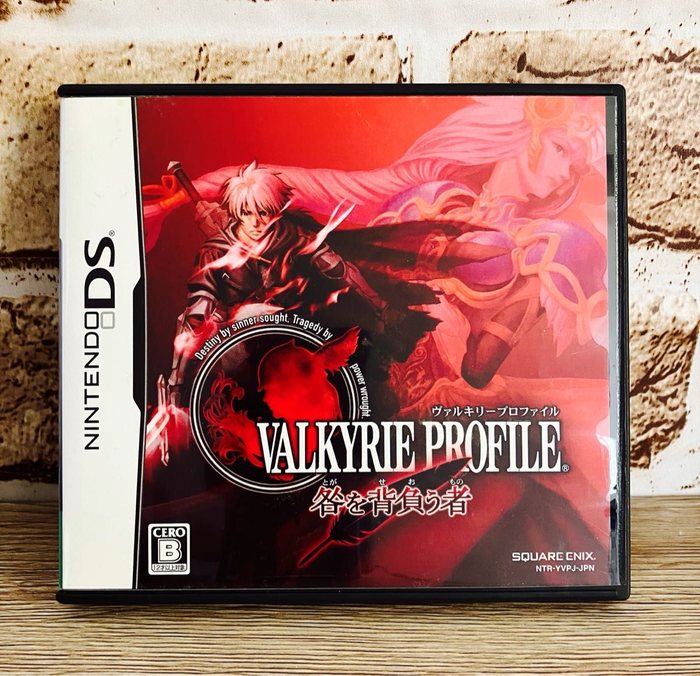
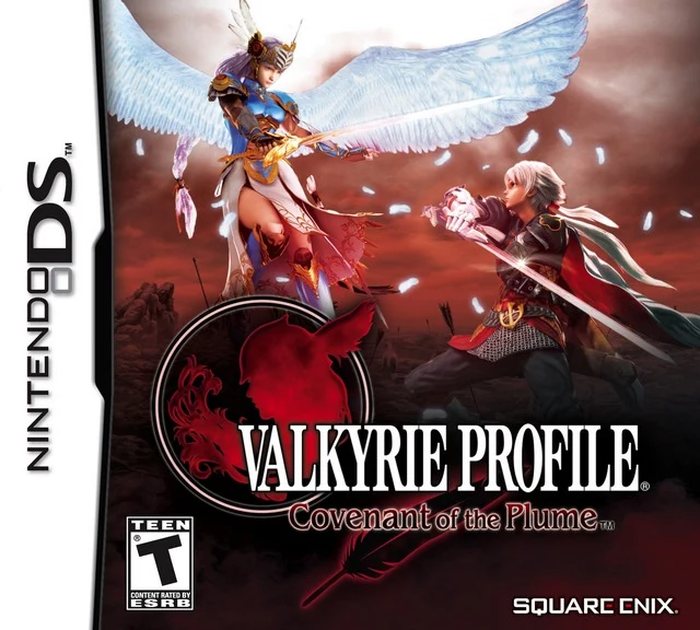
THE GAME ITSELF
Tactics, with a priceCovenant of the Plume moves the series onto a grid: turn based tactical battles in isometric arenas, four units per fight, each assigned to a DS button, with the series' combo attacks and Soul Crush finishers carried into the new form. Its signature mechanic is the Destiny Plume. Use it and a unit becomes far stronger for one battle; when the battle ends, that unit dies, permanently. Sacrificing a unit grants Wylfred a unique skill, and how often the player uses the Plume decides the story's route and its ending: used repeatedly, never, or only once, the game ends three different ways. A second pressure runs alongside: each battle demands a quota of Sin, gathered by overkilling enemies or by using the Plume, and falling short sends a powerful enemy into the next battle.
HOW IT WAS RECEIVED
The scoresTHE SALES
Documented figuresThe game debuted at number two on the Japanese charts, selling 80,000 copies, and was the 97th best selling game in Japan in 2008 with 136,948 copies. By May 2009 it had sold 230,000 copies worldwide: 160,000 in Japan, 50,000 in North America, and 20,000 in Europe, figures Square Enix reported in its own results briefing, which made it one of the company's better selling titles of that period.