
What changed in EarthBound's American localization?
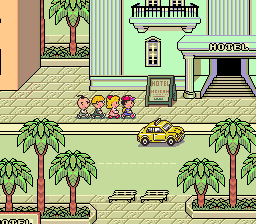
The comparison record here is unusually good, because the man who would later lead the Mother 3 fan translation, Clyde Mandelin, spent years documenting this one. His Legends of Localization project compares Mother 2 and EarthBound line by line and image by image, and eventually became a 432 page book built on that research, including interviews with EarthBound's localization editor and its head marketer. What follows is drawn from that documented comparison and from Mandelin's study of Nintendo of America's 1990s content policies, the internal rules that required death, religion, alcohol, and violence to be softened before a Japanese game could be sold in America.
The visual changes are the famous ones. Red crosses were removed from hospitals, a religion and medical symbol Nintendo's policies would not carry. Signs reading "drug" became "store," and bars became cafes, with references to alcohol rewritten as coffee, espresso, and cappuccino. The game's band, the Runaway Five, were the Tonzura Brothers in Japan, and their outfits were completely redone in the American version to avoid looking like the Blues Brothers, a change the comparison record files under graphics altered to avoid possible lawsuit problems.
The text changes run in the same direction, and one early scene shows the whole method in miniature. In Japanese, Pokey says he is going to be spanked a hundred times. In English, he says he is "gonna get it." The punishment scene that follows keeps the event and changes its sound: the heavy pounding of the Japanese version became a cartoon like angry noise, and Pokey's Japanese complaint that his butt hurt became, in English, the loss of dessert for the rest of the decade. Violence was altered wherever possible, as the comparison puts it, including simple sound effects. None of this was one translator's squeamishness: Mandelin's policy research shows the same checklist being applied across Nintendo of America's whole 1990s catalogue.
The honest verdict has two halves. The American script is a genuinely admired piece of localization, funny in its own right, and Mandelin's comparison is careful to mark the lines that were translated spectacularly alongside the ones that lost something. But the game America received is measurably tamer than the game Japan received: less religion, less alcohol, less corporal punishment, less legal risk. Collectors comparing the two boxes on this Library's gallery are, underneath the art, comparing those two rulebooks.