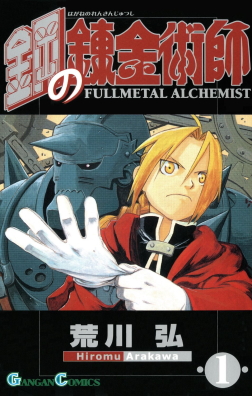
What inspired Fullmetal Alchemist?
Every claim on this page comes from Hiromu Arakawa's own statements, in interviews and in her published profiles. Start with the law the whole series runs on. Equivalent Exchange, the rule that to obtain something, something of equal value must be lost, came from her parents' work on the family dairy farm in Hokkaido, where she was raised and where she worked for seven years after high school. She told Animeland: "The more you love your animals, the more they give it back to you. Equivalent exchange is based on the energy you'll deploy to realize the task that was assigned to you. In a way, that exchange gives rhythm to my life." The philosophy is farm bookkeeping before it is magic: effort in, return out, and no exceptions for wanting.
The stone and the setting
Reading, in her accountThe premise began with reading. After reading about the philosopher's stone, Arakawa became interested in characters using alchemy, and read books on the subject, finding them complicated because some contradicted others. She has said she was drawn more to the philosophical aspects of alchemy than the practical ones, which is visible in the result: her alchemy is a moral system with a laboratory attached. The world around it came from a second body of reading, on the Industrial Revolution in Europe. She was struck by the differences in culture, architecture, and clothing from her own, and was especially interested in England of that period, influences she folded directly into Amestris and its steampunk machinery. Her stated drawing roots sit behind both: she calls Suiho Tagawa, the author of Norakuro, the root of her style as an artist, and she learned composition and drawing as an assistant to Hiroyuki Eto, alongside cited influences including Rumiko Takahashi and Shigeru Mizuki.
The conscience
Reported, not inventedArakawa wanted social issues inside the story, and her research for them was reporting, not just reading. It involved watching television news and talking to refugees, war veterans, and former yakuza. The Hokkaido ground she grew up on supplied the hardest thread. In her Newtype USA interview she addressed the history behind Ishval directly: her own ancestors were among the settlers who displaced the Ainu, the Indigenous people of Hokkaido, while some of her relatives have Ainu blood themselves, a contradiction she described as an everyday fact of life among neighbors of differing ethnicity. Scar's story, an Ishvalan using the alchemy his faith forbids to kill alchemists, carries that irony in the fiction. Other themes she built deliberately from the same material include Pinako Rockbell taking in the orphaned Elric brothers, and the brothers learning the meaning of family by helping people as they travel. In her volume 1 author note, as quoted in profiles of her, she also owned the lighter engine of the series: a fan of Indiana Jones and of B movies, the kind that make her think "what the hell is this?" and still draw her in to the end, and she invited readers to enjoy the madcap alchemy on those terms.
THE FIRST VOLUME
Fullmetal Alchemist, in print