Why does the 2003 Fullmetal Alchemist anime end differently from the manga?
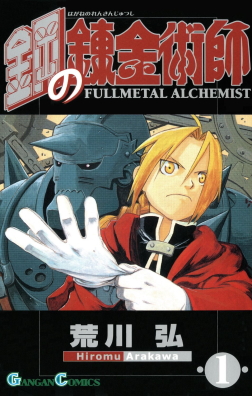
Hiromu Arakawa's manga began in the monthly magazine Monthly Shonen Gangan in July 2001. When studio Bones premiered the anime on October 4, 2003, the manga stood at roughly chapter 28 of an eventual 108, collected in about six volumes. A weekly television series burns material far faster than a monthly manga produces it, so the anime would run out of published story well before Arakawa could finish hers. Instead of filler or a stalled adaptation, Arakawa let Bones work independently and requested an original ending different from the manga. She did not want the same ending in both media, and she wanted to keep writing the manga at her own pace to develop the characters. In her 2006 Newtype USA interview she put the principle plainly: she saw little point in a cross media story if everything is exactly the same in all versions. A conversation printed in volume 4 of the anime's official fanbook records the same request in her own terms: a unique ending, different from the manga.
What they did get
The 2003 version, on its own termsThe first half adapts roughly the first six volumes, with material from volumes seven and eight recontextualized. From there, director Seiji Mizushima and writer Sho Aikawa built an original back half: the villain is Dante, a former lover of Hohenheim who has survived for centuries by moving her soul between bodies, and the Homunculi are reimagined as the products of failed human transmutations, which is why the 2003 Sloth wears Trisha Elric's face. Arakawa said she was amazed at how different the anime's Homunculi were from hers, and that she enjoyed watching the staff speculate about the villains' origins. The television ending, Edward stranded in a parallel world and Alphonse restored, was then concluded by the 2005 film Conqueror of Shamballa. None of this is the manga's ending, and by design it never could be: the manga ran for six more years, to June 2010, and closed with Father, the Promised Day, and Edward giving up his alchemy, a finale Arakawa had in mind from early on but had not yet drawn.
In the room, not shut out
Consultation and the guardrailsThe durable fan rumor says Bones changed the story on its own and enraged the author. The production record says the opposite. Arakawa attended meetings and advised the staff on the world of the series, consulted on characters, and shared the overall story she had planned so the team could fill the gaps toward their own ending; extras in manga volume 8 document that consultation. In February 2026, Aikawa added detail on the record: Arakawa gave the writers explicit points to avoid, including no flying in the sky with alchemy and no putting the protagonist on a motorcycle, and Square Enix editorial staff attended every script meeting, sometimes consulting Arakawa on the spot. Her involvement had a cost she noted herself: helping the anime left her little time for the manga's cover illustrations in that period.
One honest exception belongs on the record. In a 2004 Animedia interview, Arakawa objected to the anime's late depiction of Rose, who reappears with an infant in circumstances implying she was violated while in military custody. "It deviated from the entertainment scope of the boys' manga I aim for," she said. "That depiction should not have been allowed." That is a specific objection to one depiction, on the record. It is not fury at the adaptation, and retellings that inflate it into a feud go past what she said.
THE FIRST VOLUME
Fullmetal Alchemist, in print