
What is Lunar: Eternal Blue?
A thousand years later, a girl falls from the Blue Star, and the warmest series in RPGs turns elegiac.
Lunar: Eternal Blue is the sequel, developed by Game Arts and Studio Alex for the Mega-CD and released in Japan on December 22, 1994 (North America, September 1995). Lunar is at peace under the Goddess; then Lucia, an emissary from the ruined Blue Star, arrives to destroy the dark god Zophar before he wakes, and an archaeologist's grandson named Hiro decides her mission is his too. Where The Silver Star is a boy becoming a hero, Eternal Blue is a world deciding whether it still needs gods at all.
THE LARGER GAME
Mega-CD, pushed to its edge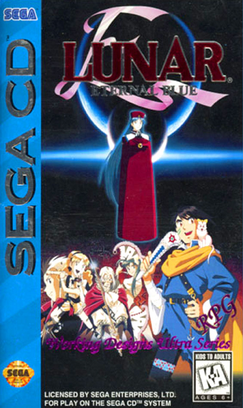
Lucia of the Blue Star
Kubooka's cover for the sequel: Lucia suspended above a world that does not know her. Eternal Blue's art leans colder and stranger than its predecessor's, and its reputation has grown accordingly: many fans now rank it above the original.
Sixty sequences
The original carries some sixty animated sequences, from full scenes to brief scene-setters: the Mega-CD's most ambitious film program. The Japanese box also hid a bonus mini-CD with two songs and comic skits among the cast.
Magic Experience
The original's signature system: spells improve with use, fed by Magic Experience points earned apart from ordinary experience. The remake dropped it, which is why the two Eternal Blues play more differently than the two Silver Stars do.
THE SHAPE OF THE STORY
Why it lastsAn epilogue with its own game attached
Eternal Blue famously continues past its ending: after Zophar falls, a full epilogue sends Hiro after Lucia across a healed world. In 1994, a post-game quest of that size was close to unheard of, and it is the sequence the fan base quotes most.
The sought-after disc
Eternal Blue never received its predecessor's flood of re-releases; its last physical printing for decades was the PlayStation remake of 1999-2000. The Sega CD original is, as a result, one of the most sought-after discs on the system.