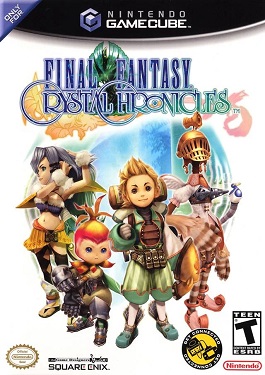
Why Did Final Fantasy Crystal Chronicles Need Game Boy Advances for Multiplayer?
In Final Fantasy Crystal Chronicles (GameCube, 2003), one player can play alone with a normal controller. But two to four players each need a Game Boy Advance and a GameCube to Game Boy Advance link cable, used as that player's controller. It was the first role-playing game built on GameCube to Game Boy Advance connectivity, it drew complaints from the day it was announced, and the game's producer explained the reasoning on the record. This page gives his reasons, the business context behind them, and what the experiment cost.
THE DESIGN REASON
Producer Akitoshi Kawazu, on the record (Tier 1)The basic concept of the game, in Kawazu's own account, was to build a game around use of the link cable. His stated reason for the Game Boy Advance was that it would introduce different elements of gameplay: each player's handheld is a private screen, carrying that player's menus, maps and information, and a player can choose to share what their screen shows with the group or keep it to themselves. No shared television screen can do that. Reviewers who played it confirmed the mechanism worked as designed: menus, equipment and trading happen on the handheld without pausing the action for everyone else, spell fusion is coordinated across four private inventories, and even the single player game can use a connected Game Boy Advance as a second screen for radar, its display set by painting your Moogle.
The rest of the design was bent to serve group play the same way. Experience point leveling was removed, Kawazu's team has explained, to keep a level field between players of different strengths. The battle system is real time action rather than the series' Active Time Battle, chosen so more people could enjoy the gameplay. The requirement was the visible tip of a whole design philosophy: this Final Fantasy was built for a room of friends first.
THE BUSINESS CONTEXT
Why a cable game existed at allCrystal Chronicles was the first original Final Fantasy for a Nintendo console since Final Fantasy VI in 1994, made after Square and Nintendo reconciled, through a shell company, The Game Designers Studio, with support from Nintendo's Q Fund for GameCube and Game Boy Advance developers. GameCube to Game Boy Advance connectivity was Nintendo's signature hardware idea of that generation, and a flagship Square game built entirely around it served both companies: Nintendo got proof of concept with the biggest name in RPGs, and Square got its return to Nintendo hardware wrapped around Nintendo's own feature. Kawazu has also said the later Crystal Chronicles games stayed on Nintendo consoles as an act of loyalty to the company that first requested a game. The Japanese release even packaged a link cable with the game.
THE COST
Kawazu's own verdict, later (Tier 1)The barrier was real, and the reviews said so at the time: IGN praised the concepts while noting the steep entry requirements for multiplayer, and GameSpot's reviewer enjoyed the game despite faulting its high hardware demands for the full experience. A four player session meant four handhelds and four cables in one room. Kawazu himself later conceded the point, saying this type of multiplayer meant the entry was a bit high for potential players. The game still shipped over 1.3 million copies, took the Grand Prize at the 2003 Japan Media Arts Festival for its multiplayer and graphics, and was later called, by Eurogamer's retrospective, the most fully featured implementation of GameCube to Game Boy Advance connectivity ever created.
WHAT THEY DID INSTEAD, LATER
The remaster removed the cable, and the couch went with itWhen the game returned as Final Fantasy Crystal Chronicles Remastered Edition in 2020, for Switch, PlayStation 4 and phones, the link cable design had no modern equivalent to map onto. The team chose online multiplayer over local, and said so plainly: local and online could not both be done, so they picked the option that let the most people play. The Game Boy Advance requirement disappeared, and so did the room full of friends on private screens that the whole design had been built to create. The remaster's mixed reception, 62 on Metacritic, is partly the sound of that trade. The original's strangest demand and its best idea were the same thing.
THE GAME ON THE SHELF
Crystal Chronicles