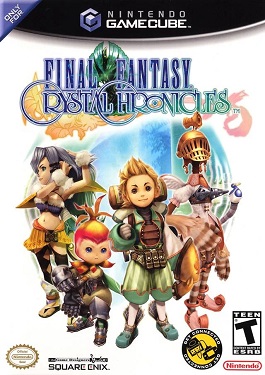
The History of Final Fantasy Crystal Chronicles
Final Fantasy Crystal Chronicles (GameCube, 2003) was developed by The Game Designers Studio and created and produced by Akitoshi Kawazu, the SaGa designer. It was directed by Kazuhiko Aoki, a Final Fantasy IX veteran, with character designs by Toshiyuki Itahana, also of Final Fantasy IX, a scenario by Masahiro Kataoka, and music by Kumi Tanioka. A thousand years after a meteor shattered the Great Crystal, the world is covered in poisonous Miasma, and every village survives behind a crystal that must be fed drops of myrrh. Your caravan walks out each year to gather them, staying alive inside the small circle of safety around the vessel it carries.
THE MAKING
A shell company, a fund, and a reconciliationThe game exists because of a corporate repair job. Square had broken with Nintendo in 1996 to build Final Fantasy VII for PlayStation, and the rift lasted years. In 2001 the film Final Fantasy: The Spirits Within failed financially, Sony bought a nineteen percent stake in Square, and Square, still in poor shape and trying to keep its staff, decided to develop for Nintendo consoles again. Sony agreed, on the condition that PlayStation 2 work would not be affected. The vehicle was a shell company co-owned by Square and Kawazu, The Game Designers Studio, and Nintendo supported the project through the Q Fund, Hiroshi Yamauchi's fund for first time GameCube and Game Boy Advance developers. Development began in late 2001. It was the first original Final Fantasy title for a Nintendo console since Final Fantasy VI in 1994, and it remains the only game the studio ever made for the GameCube.
Kawazu's design brief inverted the series. Where Final Fantasy was narrative driven, this game would be gameplay driven, with story carried by encounters and environment. He wanted player freedom, as in his SaGa games, and an audience wider than the series' usual: the Active Time Battle system was dropped for real time action so more people could enjoy it, and experience point leveling was removed entirely, so a group of friends at different strengths could play on a level field.
THE DESIGN
Built around the link cable, on purposeThe basic concept, in Kawazu's own account, was to build a game around use of the link cable. In multiplayer, up to four players each plug a Game Boy Advance into the GameCube and play from it: the television shows the shared world, while each Game Boy carries that player's menus, maps and private information, which the player can share with the group or keep. Kawazu explained that the Game Boy Advance would introduce different elements of gameplay, and the design follows through: spell fusion rewards coordination, dungeon bonuses go to the session's best player, and nobody ever pauses the game to open a menu. The companion question page in this archive documents the requirement and its cost in full.
Alone, a Moogle carries the vessel for you; the role was first planned for a human sidekick and became a Moogle once multiplayer's shape was considered. The four tribes, Clavats, Lilties, Selkies and Yukes, were designed with silhouettes distinct enough to read at a glance in a crowd of players; Itahana's original cat-like tribe was replaced by the plant themed Lilties after Kawazu, in his word, hated the design. Tanioka and programmer arranger Hidenori Iwasaki scored it exclusively on period instruments, recorder, crumhorn and lute among them, performed by the Roba Music Theater, with the vocal themes Kaze no Ne and Hoshizukiyo sung by Yae Fujimoto in Japanese and Donna Burke in English.
THE EDITIONS
Nintendo publishes the returnTHE RECEPTION
80, a Grand Prize, and one famous panTHE LEGACY
1.3 million shipped, and a door reopenedThe game sold over 179,500 copies in its Japanese debut week at number two, reached nearly 355,000 in Japan by 2004 as the country's twenty-eighth best selling title of the year, and lifted GameCube sales that August. It was the best selling game of its release month in North America, topped the United Kingdom GameCube chart for two weeks, and passed 1.3 million copies shipped worldwide by October 2007.
Its largest legacy is not a number. Crystal Chronicles proved Square and Nintendo could work together again, on Nintendo hardware, with Nintendo publishing, and it founded a Final Fantasy subseries that ran for six more games across two more Nintendo consoles. It is filed in this Library's Final Fantasy archive, where its parent series lives, and it stands on the GameCube gallery as that shelf's Square exhibit.
THE GAME ON THE SHELF
Crystal Chronicles · GameCube