
Why did Fire Emblem stay in Japan for thirteen years?
From April 20, 1990 to March 29, 2002, six Fire Emblem games were released in Japan and nowhere else: the Famicom pair, the Super Famicom trilogy, and the first Game Boy Advance game. The documented reasons the series stayed home were practical, not mysterious. Localizing a Fire Emblem meant translating an extensive amount of text; Nintendo held the view that tactical role-playing games would be met with low sales overseas; and the series' difficulty was itself a stated concern, the reason the games remained exclusive while other Nintendo series traveled.
The first proof came from Intelligent Systems' other strategy series. Director Kentaro Nishimura, who worked on both Advance Wars and Fire Emblem, recalled the assumption from inside Nintendo: "When I joined Nintendo, I was told that these kinds of games would never be successful abroad, because they were turn-based games, and turn-based games weren't appreciated outside Japan." The Advance Wars team answered by making their game easy to learn, with a strong tutorial, even though there was no plan to release it abroad. American marketing staff played it and asked why they could not sell it. In Nishimura's summary, Advance Wars' success shifted Nintendo's attitude over western tastes, and he has said plainly that Fire Emblem would never have been released in the West had Advance Wars not paved the way.
The second proof was accidental casting. Masahiro Sakurai had wanted Marth in Super Smash Bros. since the first game, and added him to Super Smash Bros. Melee (2001) in a push for more sword wielding characters; Roy followed as his clone, partly to advertise The Binding Blade, which reached Japan three months after Melee. Keeping the pair in the Western version was difficult precisely because their series had never left Japan, and it took support from Nintendo of America to keep them. Both characters still spoke Japanese in the Western release. Western players made them popular anyway, and that popularity is documented as the spark that turned a possibility into a decision.
The game Nintendo chose to open the door was built for strangers. Fire Emblem: The Blazing Blade (2003) opens with Lyn's story, an extended tutorial introduction written into the plot, because the series' steep difficulty was proving off-putting to new players; the developers have said the tutorial existed to help make Fire Emblem a major series for Nintendo. It shipped in Japan on April 25, 2003, reached North America on November 3, 2003 under the plain title Fire Emblem, and Europe on July 16, 2004. It scored 88 on Metacritic, and its overseas commercial success is what the developers later credited with prompting the return to home consoles in Path of Radiance.
Two footnotes complete the record. Roy's own game never followed him West: Nintendo of America was willing to localize The Binding Blade, but the workload of localizing The Sacred Stones meant the idea was scrapped, and it remains Japan only. And the door never quite closed again: every later Fire Emblem was localized except one, New Mystery of the Emblem in 2010, the last game in the series to stay in Japan.
The first to leave, and the proof it worked
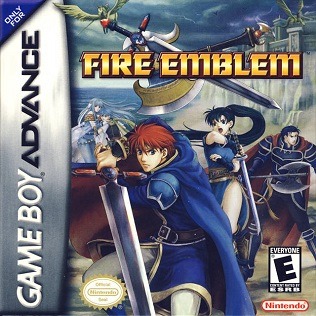
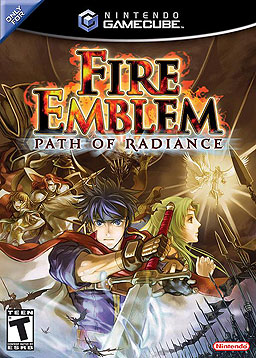
Thirteen years of Japan only releases ended with a Game Boy Advance cartridge whose cover does not even carry a subtitle. Its success bought the series a GameCube game two years later.