
From the Library: covers, censuses, and editions, documented. Browse the Library →
SOJ The Design · Disney
← Back to the Library

Why does Sora transform in Disney worlds?

Because the story says a visitor must not look like one, and the art department treated that rule as a gift.

The in-fiction reason is stated in the first game: each world must never learn that other worlds exist, so when the party arrives somewhere whose natives would notice three armed tourists, Donald Duck’s magic rewrites their shapes to match the local population. The rule, the “world order,” turns a licensing constraint into one of the series’ great design traditions: a new set of Nomura drawings for every world that needs them.

Kingdom Hearts set the pattern with two transformations. In Atlantica, Sora becomes a merman, Donald an octopus, Goofy a sea turtle, and the game’s combat goes fully underwater. In Halloween Town, Sora is a small vampire in a pumpkin mask, Donald a mummy, Goofy a stitched Frankenstein creature, designs that have become some of the most merchandised images in the series. Kingdom Hearts II expanded the wardrobe: a lion-cub Sora in the Pride Lands (with Donald as a hornbill-like bird and Goofy as a tortoise), glowing data forms in Space Paranoids, black-and-white 1920s cartoon forms in Timeless River, and a Santa-suited variant for Christmas Town on the return trip to Halloween Town.

Kingdom Hearts III kept the tradition where the worlds demanded it: action-figure toy forms in Toy Box, monster forms in Monstropolis, and pirate dress in The Caribbean, where the transformation is costume and complexion rather than species. The design discipline is consistent across twenty years: whatever changes, Sora’s spiky silhouette, crown necklace, and color blocking survive, so the hero stays readable at a glance in any world’s art style. That readability is why the forms work as merchandise: each one is unmistakably Sora and unmistakably somewhere else.
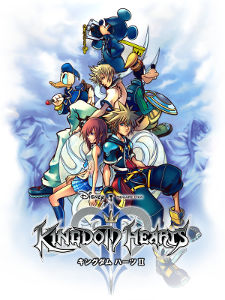
Kingdom Hearts II Japanese PlayStation 2 box
KINGDOM HEARTS IIThe Japanese box for Kingdom Hearts II, the game that dressed Sora for each world he entered.

THE FORM LEDGER

World by world
Atlantica · KH & KH II
Merman Sora, octopus Donald, turtle Goofy. The transformation that also rewires combat into three-dimensional swimming.
Halloween Town · KH & KH II
Vampire Sora with a pumpkin mask; mummy Donald; Franken-Goofy. Return visits add Christmas Town dress in Final Mix and II.
Pride Lands · KH II
Lion-cub Sora, the most radical redesign in the series: four legs, no Keyblade in hand, the blade carried in his mouth.
Timeless River · KH II
The party redrawn as 1928 rubber-hose cartoons, monochrome with pie-cut eyes: a world where the art style itself is the disguise.
Toy Box · KH III
Sora, Donald, and Goofy as poseable action figures, with visible joints and plastic sheen, designed alongside Pixar.
Monstropolis · KH III
Fur, horns, and a single great eye between them: the forms built to pass unnoticed on the scare floor.

THE DESIGN RULE UNDERNEATH

What never changes
The silhouette
Hair first. Sora’s spikes are drawn before any species decision, and they survive every transformation.
The crown
The necklace stays on a merman, a lion, and a toy. It is the brand mark the forms are not allowed to lose.
More from the Library →Disney’s rules →The merchandise landscape →
MORE FROM THE KINGDOM HEARTS ARCHIVE →
One shelf of the Library. Browse them all →

THE FIRST WORD

New pages and new pieces, first.