
From the Library: covers, censuses, and editions, documented. Browse the Library →
SOJ Trigun · The 1998 Anime
← Back to the Library

Why does the 1998 Trigun anime end differently from the manga?

Spoiler warning: this page describes both endings. The manga had no ending yet. The anime had to invent one.

The arithmetic is the whole answer. Madhouse's Trigun, directed by Satoshi Nishimura with series composition by Yosuke Kuroda and music by Tsuneo Imahori, aired for 26 episodes on TV Tokyo from April to September 1998. At that moment the manga's original run had already been cut short by its magazine's closure, and Trigun Maximum had only resumed in October 1997. Nightow would keep writing it until March 2007, nearly nine years after the anime ended. The documented summary is plain: despite being an adaptation, the narrative differs in the second half because Nightow was still writing the manga at that time.

So the anime built its own road to a finish. Kuroda proposed that Vash not fire a bullet until the fifth episode, so that Meryl's realization lands as a reveal. From there the production gradually reduced the early comedic tone in favor of more dramatic storylines, and the introduction of Nicholas D. Wolfwood in episode nine shifted the series again, with Wolfwood written as both Vash's ally and his rival. A 26 episode broadcast series could not stop where the manga stopped. It needed a confrontation with Knives, and it wrote one.

Nightow's own verdict on the result is on the record, and it is not a complaint: after assisting Madhouse with the adaptation, he considered the work faithful to the manga and credited it with helping him properly serialize the story. The two endings are not a betrayal and an original. They are a finished broadcast invention from 1998, and a manga ending that did not exist until years later.

THE TWO ENDINGS, ITEMIZED

Same brothers, different finishes
Legato
Both versions force the same crisis: Vash breaks his rule and kills Legato to save the people Legato is using as weapons, Meryl and Milly in the anime telling. The sin is shared. What follows it is not.
The anime ending
Vash faces and defeats Knives, whose fate is left ambiguous. He discards the red coat that marked Rem's influence over him, adopts a new way of life, and returns to Meryl and Milly carrying his brother's body. The story closes there, in 1998.
The manga ending
The manga runs on for years: Wolfwood dies, his friend Livio joins Vash's cause, Knives advances with the Ark, ships from Earth arrive, and Vash's blond hair turns black from overusing the Angel Arm. Knives, defeated, spends his last powers creating a small fruit tree to feed his weakened brother, and dies. Vash continues his travels with Meryl and Milly.
What the anime could not use
The Ark, Livio, the Earth fleet, and Knives' death were all written after the broadcast ended. None of them existed in print for Madhouse to adapt in the spring and summer of 1998.
The tone decision
Kuroda wanted Trigun to avoid philosophical pretensions and embrace a cheesy tone, per the production record, even as the second half darkened. The anime ending's restraint about Knives is that choice, applied at the finish line.

THE BOOK ON THE SHELF

Trigun, the source
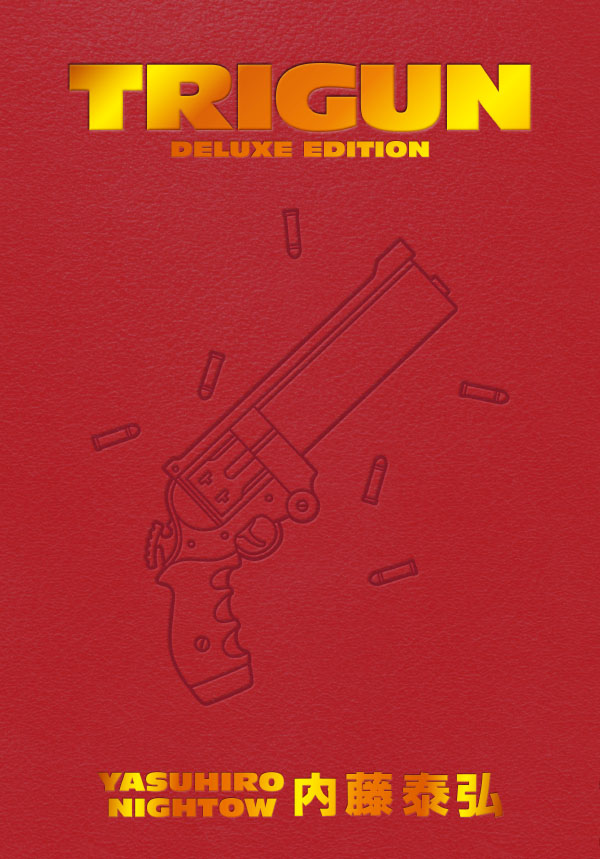
Trigun Deluxe Edition cover, Dark Horse, showing Vash's revolver embossed on red
Trigun · Deluxe Edition · Dark Horse
The Dark Horse Deluxe Edition cover of Trigun, the manga the 1998 anime, the version compared on this page, outran and ended on its own.
Why Trigun became MaximumWhy Stampede reimagined itBack to the Library
MORE FROM THE TRIGUN ARCHIVE →
One shelf of eighty-two in the Library. Browse them all →

THE FIRST WORD

New pages and new pieces, first.