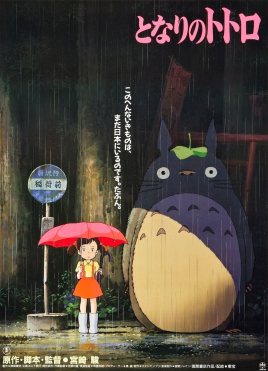
Why does the My Neighbor Totoro poster show a girl who is not in the film?
Look at the poster closely and then at the film. The poster shows one small girl at a bus stop in the rain, umbrella up, standing beside Totoro. The film's bus stop scene has two girls: Satsuki, about ten, carrying her sister Mei, about four, asleep on her back. The poster girl matches neither sister. She wears Satsuki's clothes and has Mei's pigtails, as if one character had been divided into two, which is close to what the record says happened.
The production record is direct about the starting point. Only one young girl, rather than two sisters, appears in several of Miyazaki's initial conceptual watercolor paintings, as well as on the theatrical release poster and on later home video releases. Miyazaki's own explanation for the split is practical and a little wistful: "If she was a little girl who plays around in the yard, she wouldn't be meeting her father at a bus stop, so we had to come up with two girls instead. And that was difficult." A yard player and a bus stop waiter are different ages, so one girl became an older sister and a younger one.
A second documented pressure pushed the same way. When Totoro played on Japanese television's Friday Road Show slot, the production trivia published with the broadcast explained that the main character was originally set to be only one girl, and that Miyazaki moved to two girls after learning that Grave of the Fireflies, the film Totoro would screen alongside as a double bill, was running longer than planned, so that Totoro's screentime would be about the same. The same trivia answers the poster directly: "The composition of Satsuki and Mei next to Totoro was also considered for the visual on the poster, but the design didn't turn out well, so in the end, the characteristics of Satsuki and Mei were combined into one girl, and the poster was produced."
The longer account, drawn from a producer Toshio Suzuki interview and from animator Hirokatsu Kihara's book about the production, adds the origin and the afterlife. Totoro began as a picture book whose cover featured just one young girl. When the poster was made, Miyazaki worked through several revisions and in the end reverted to that original character. And the poster then simply stayed: the film was not a huge success on first release, it became a sleeper hit through repeated television broadcasts, no inquiries about the girl ever arrived, and the studio never had a reason to change it.
The two accounts differ in emphasis, one on the story's internal logic and one on the double bill's running time, and this page prints both rather than forcing them into a single tidy cause. What every account agrees on is the shape of the answer: the film was built around one girl, production split her into Satsuki and Mei, and the most famous image of the film kept the girl who existed first. She is still there today, on the poster, on home video, and on streaming art, the first Totoro heroine, in a film she is not in.
THE POSTER
The image that outlived its character