
Why Does Illusion of Gaia Visit Real Places?
Illusion of Gaia (Japan, November 27, 1993, as Gaia Gensōki; North America, September 1994; Europe as Illusion of Time) is set in a fantasy version of the real Earth during the Age of Exploration, in a world where Columbus-era sailors chase the secrets of the Tower of Babel and many never come back. Will, the hero, is the sole survivor of his explorer father's last expedition, and he cannot remember how he lived. The game sends him across the actual wonders of the world: Incan ruins, the Nazca Lines, Angkor Wat, the Great Wall of China, and the Egyptian pyramids, each ruin holding a piece of the final puzzle at Babel.
The real geography does design work. Each landmark is a dungeon with a Mystic Statue at the end of it, and the journey between them plays like the age it imitates: port towns, ships, deserts, the open map of a planet its own characters are still mapping. At Angkor Wat, Will learns the game's thesis: an approaching comet, an ancient weapon from an earlier age, has warped the evolution of the world each time it passed. The ruins are old because something kept interrupting the world that built them.
It is also the trilogy's most literary production. Character designs are by Moto Hagio, one of the great shōjo manga artists, and the story is by science fiction novelist Mariko Ōhara. The ending matches that pedigree: Will and Kara save the world, are told they will forget everything, and the final scene shows the friends together in what looks like a modern-day school, reunited in a world that no longer remembers why. Quintet would answer Gaia's interrupted evolution with Terranigma's full resurrection two years later.
TWO TITLES, TWO BOXES
Gaia Gensōki and Illusion of GaiaThe Japanese and American covers
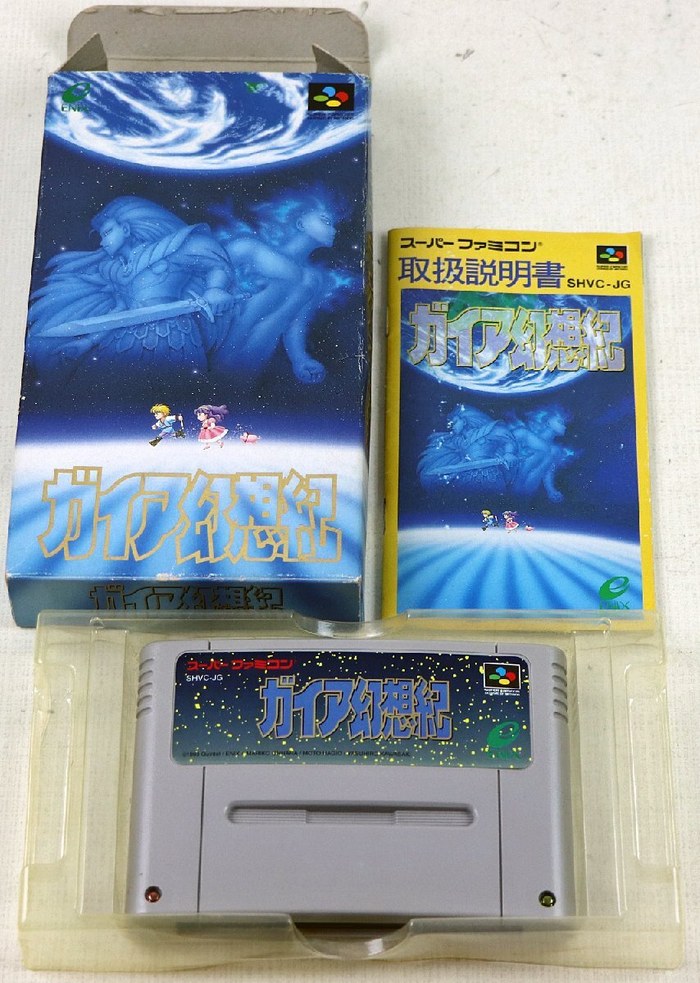
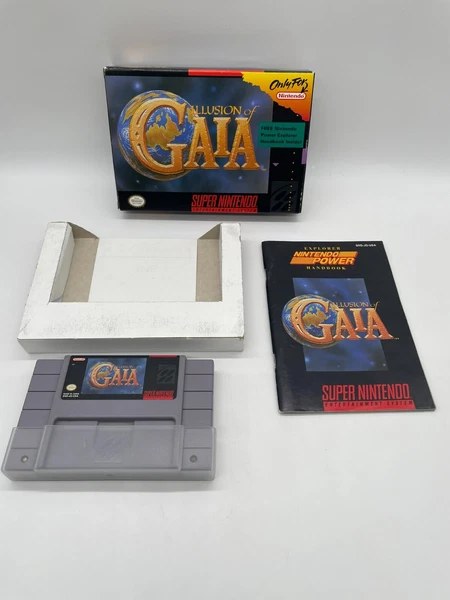
In PAL territories the game is Illusion of Time, a third name for the same cartridge. The French edition went further than a rename: it rewrote references to point at figures like Edgar Degas, Franz Kafka, and Nosferatu.