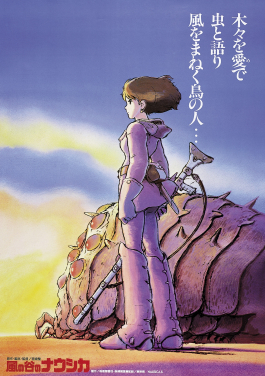
Why was Nausicaa of the Valley of the Wind not a Studio Ghibli film?
Start with the two dates, because they settle the question on their own. Nausicaa of the Valley of the Wind was released in Japan on March 11, 1984. Studio Ghibli was founded on June 15, 1985. The film came first, by more than a year, and its production company is printed in its own record without ambiguity: Topcraft, distributed by Toei Company.
Topcraft was not an accident. The film began as Miyazaki's manga, serialized in Tokuma Shoten's magazine Animage from 1982. Tokuma Shoten did not own an animation studio, so an outside studio had to make the film. Miyazaki and producer Isao Takahata chose the minor studio Topcraft, whose work both men knew, because its artistic talent could carry the manga's sophisticated atmosphere to the screen. Miyazaki himself had at first refused to adapt the manga at all; he agreed on the condition that he could direct.
The production was small and fast. Pre-production began on May 31, 1983, animation work began that August, and the film was made on a schedule of only nine months on a budget equivalent to about US$1 million, by animators paid by the frame. One of them was a young Hideaki Anno, assigned the Giant Warrior attack sequence that producer Toshio Suzuki has called a high point in the film.
Then the film changed what came next. Its success is documented as the event Studio Ghibli was founded after: Miyazaki, Takahata, and Suzuki founded the studio in 1985 after acquiring Topcraft's assets, and the first film actually made by Studio Ghibli was Castle in the Sky in 1986. Nausicaa is, in the record's own careful phrasing, a film that was released before Studio Ghibli was founded, is often considered a Ghibli work, and is usually released as part of DVD and Blu-ray collections of Ghibli work.
So the honest label has two halves, and this page prints both. On the shelf, in the collections, it sits with the Ghibli films, and its themes and makers are continuous with everything the studio later did. On the production record, it is a Topcraft film that predates the studio. The second half is the answer to the question; the first half is why the question keeps being asked.
THE TIMELINE
Four dates decide itTHE POSTER
Topcraft, 1984