Why was Tengai Makyou II never released outside Japan?
The verdict: Tengai Makyou II: Manji Maru (1992) was Japan's best selling PC Engine game of all time as of 1993, the highest rated game in PC Engine Fan's history, and 12th in Famitsu readers' 2006 poll of favorite games of all time. It was never published outside Japan, in the original or in any of its remakes. The reason why has two documented halves: the American TurboGrafx market was collapsing, removing the publisher economics for any large localization; and this game, with three hours of voiced speech, over 90 minutes of animation, and text at a 500 million yen production's scale, was the largest localization job its platform could have asked for.
WHAT ALMOST HAPPENED
Previewed in America, ranked first by the man who would knowThe West did not ignore it. TurboPlay, the American TurboGrafx magazine, previewed it in 1992 as Ziria: Far East of Eden 2, and series historians record that American release plans existed and were scrapped as the platform failed. The strongest single piece of Western evidence is Victor Ireland's: the president of Working Designs, the company that localized Lunar and Cosmic Fantasy 2 for the same hardware generation, ranked Tengai Makyou II number one on his personal list of the greatest games of all time in Electronic Gaming Monthly in 1997. The man whose business was bringing exactly this kind of game west rated it first, and it still never came: the constraint was the platform and the scale, not the game's standing with the people who did this work.
WHAT THEY DID GET
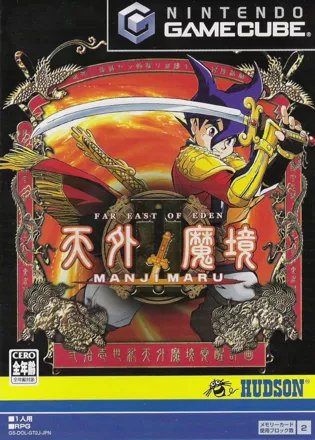
The West's Far East of Eden, in piecesAmerican players met the series sideways: the Neo Geo fighting game Kabuki Klash brought its characters over as fighters, and Manjimaru appeared as a guest in Saturn Bomberman in Japan. The game's own remakes stayed home too: GameCube and PlayStation 2 in 2003 (197,010 copies between them in Japan), Nintendo DS in 2006, the PC Engine original on PlayStation Network in 2011, and a place in the Japanese PC Engine Mini in 2020 that the Western mini consoles did not share. To this day there is no complete fan translation either, so the usual unofficial door is closed as well. The 12th favorite game of all time in Japan remains, in English, a game you can only read about, which is why this Library documents it at full length.
THE GAME ON THE SHELF
Tengai Makyou II, the remake