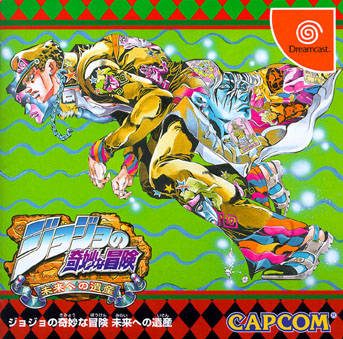
How Do Stands Work in JoJo's Bizarre Adventure?
A Stand is a fighting spirit that stands beside its user, and Capcom built JoJo's Bizarre Adventure (arcade 1998, Dreamcast 1999) around a single button that summons and dismisses it. This page explains the system plainly: what changes when the Stand is out, what it costs you, and the exceptions Capcom built in for characters the rules do not fit.
THE STAND BUTTON
A second fighter you switch on and offEvery other fighting game gives you one body. JoJo gives you a body and a guardian spirit. Press the Stand button and your Stand, a visible fighting spirit like Jotaro's Star Platinum, appears beside you; press it again and it withdraws. With the Stand out, your move list changes, your reach grows, and you gain a double jump. With it put away, you are smaller, quicker to recover, and harder to hit. Learning a character means learning two movesets and the moments to trade one for the other.
The Stand can also be sent to attack separately from its user, which is how the game puts up to four characters on screen at once: two fighters and two Stands, all animated on the CPS-3 board.
THE RISK BUILT IN
Hit the Stand, hurt the masterThe system balances itself with a rule straight out of the manga: damage done to a Stand is done to its user, and if the Stand is far from its user when hit, the damage is doubled. A Stand also has its own Stand Gauge; empty it and the Stand breaks, a Stand Crash that leaves the user stunned and open. Sending your Stand across the screen is the game's biggest weapon and its biggest liability at the same time.
When two rapid fire attacks meet, the game stages Blazing Fists clashes, the button mashing duels of fists that Araki's panels made famous. Some characters break the pattern entirely: their Stands are passive, always active as a property rather than a summoned partner, and Young Joseph has no Stand at all, fighting with the Hamon techniques of his own era.
WHY IT MATTERS
The mechanic is the adaptationStands are why this game could not have been a reskin. The risk, the range, the double jump, and the crashes all come from the logic of the manga's powers rather than from fighting game convention, which is a large part of why the game is remembered as an adaptation first and a licensed product second. The full production story is on the history page.
THE GAME ON THE SHELF
JoJo's Bizarre Adventure · Dreamcast