
The History of JoJo's Bizarre Adventure
JoJo's Bizarre Adventure (arcade 1998, Dreamcast 1999) is Capcom's fighting game of Hirohiko Araki's Stardust Crusaders, built on the animation rich CPS-3 board. Its revision, Heritage for the Future (1999), was the last CPS-3 game ever made, and the Dreamcast version carries both arcade games on one disc, which is why collectors still treat it as the complete edition.
THE MAKING
The Street Fighter III team draws a mangaJoJo's Bizarre Adventure began as an act of translation: Capcom's CPS-3 arcade hardware, and the team behind Street Fighter III, set to animating Hirohiko Araki's manga. The game's story is the manga's third part, Stardust Crusaders: Jotaro Kujo travels to Egypt to kill the vampire Dio and save his mother, and the fighters are the Stand users met along that road. What a Stand is, and how Capcom turned one into a fighting game system, is a question of its own on this shelf: how Stands work.
Araki himself was inside the production rather than outside it: he served as a consultant on the game and created exclusive artwork for its promotion and packaging, including designing one character from scratch. That story has its own page too: what Araki did for the game.
TWO ARCADE GAMES IN TWO YEARS
Venture, then Heritage for the FutureThe first arcade release reached Japanese arcades in December 1998, exported under the name JOJO's Venture, with 13 playable characters. Less than a year later, in September 1999, Capcom released the revision, JoJo's Bizarre Adventure: Heritage for the Future, expanding the roster to 22. Heritage was the sixth and last game ever made for the CPS-3 board, the end of the line for Capcom's most animation rich arcade hardware.
Japanese players took to both. Game Machine ranked the original the most successful arcade game of January 1999 and Heritage the most successful of November 1999, and the game finished as the third highest grossing arcade software of 1999 in Japan.
THE HOME VERSIONS
Two different answers on two machinesThe PlayStation version (Japan October 14, 1999; North America April 10, 2000) is a mixture: built mainly on the original arcade game, borrowing some of Heritage's characters, and adding an exclusive Super Story Mode that retells Stardust Crusaders in mini games and fights.
The Dreamcast version (Japan November 25, 1999; North America and the UK April 28, 2000) answers differently: it carries both arcade games, in their original forms, on one disc. Why that makes it the complete arcade version is laid out at two games on one disc. Japan also received an online enabled update in 2000, sold only there. A downloadable HD version reached PlayStation 3 and Xbox 360 in August 2012 and was delisted on September 11, 2014, which returned the Dreamcast disc to its old position: the fullest way to own the game.
THE COVERS
Japan and America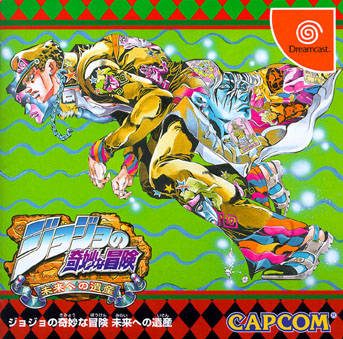
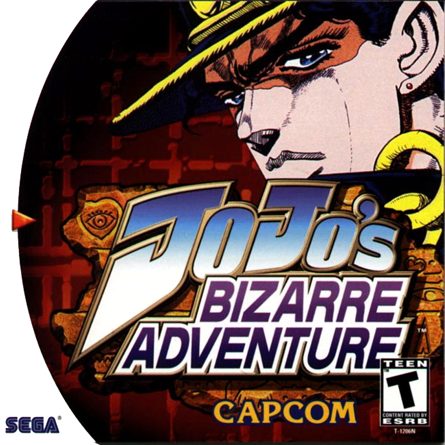
The Japanese box is Araki's manga energy at full stretch, Jotaro mid pose, Star Platinum behind him, the Heritage for the Future subtitle on the logo. The American box crops the idea down to a single painted close up of Jotaro's face. The Japanese cover shown here is a small scan, the best genuine file found; it is flagged for a larger swap in when one surfaces.
THE RECEPTION
Loved in the West, argued about in printThe Dreamcast version reviewed strongly in the West: GameSpot 8.3, IGN 8.5, Game Informer 8, EGM 7.625, Eurogamer 8, GameFan 85 percent. Famitsu scored both home versions 31 of 40. The dissent is part of the record too: Edge gave it 5 of 10 and AllGame 2 of 5, a genuine split for a game whose charms are inseparable from its source material.
The home versions together sold over 300,000 units in Japan by March 2000. For a faithful port of a manga fighting game, that is a best seller, and it is the commercial footprint behind this game's reputation: the weird one that worked.