
From the Library: covers, censuses, and editions, documented. Browse the Library →
SOJ My Hero Academia · The Drawing
← Back to the Library

How does Kohei Horikoshi draw?

The hands give it away: Naruto taught him to love drawing them.

Horikoshi has talked about his own drawing more than most Jump authors. The headline influence is specific: he has said that Naruto “gave him a love for drawing hands,” and called Masashi Kishimoto his biggest artistic influence, with Dragon Ball behind that. Yuko Osada is the artist he has most wanted to emulate. On the American side, he is a Marvel fan and figure collector, and the superhero anatomy of the series, capes, cowls, and engineered costumes, comes straight off that shelf.

The postscripts in the manga volumes are the other half of the record: thousands of words of the author talking to his readers about the work, his obsessions (horror is the pleasure he admits to, and drawing villains is where it shows; Fat Gum’s mood famously swings with his own), and, by volume 30, a plain health warning to his readers that he had pushed himself too hard. Judge the art by the wall: all forty-two covers on the gallery page are his paintings.
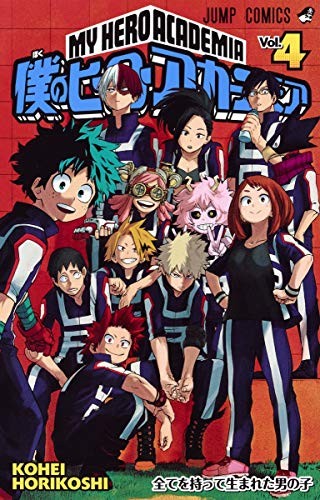
My Hero Academia volume 4 cover
My Hero Academia, Vol. 4
Volume 4 (2015). The Sports Festival arc is where his crowd scenes and action staging take off.

THE INFLUENCES, NAMED

His own account
Kishimoto’s hands
The close-read detail of the style: hands everywhere, expressive and oversized. Midoriya’s scarred hand on the volume 41 cover is the influence made literal.
Toriyama’s shelf
Dragon Ball from childhood, and Akira Toriyama’s single-volume short works collected at home: economy of line learned from the master of it.
The figure shelf
Marvel fandom as research: he collected the figures and has said he studied toys when designing costumes and gear. His movie posters for film and game tie-ins dot the series’ promotion years.

THE PROCESS, IN THE POSTSCRIPTS

What the volumes confess
The horror streak
He loves horror and says so repeatedly; it surfaces in the villains’ designs and in the series’ darkest covers, volumes 24 and 25 especially.
The mood gauge
Fans read the postscript Fat Gum drawings as a health bar: thin when the author was swamped, round when he was rested. It is a fandom joke he played along with for years.
The warning
In later volumes the jokes thin out into candour about exhaustion and pain. The final arc’s slower pace, and the ending on his terms, belong to the same record.

THE MY HERO ACADEMIA SHELF

More from this archive
More from the Library
MORE FROM THE MY HERO ACADEMIA ARCHIVE →
One shelf of the Library. Browse them all →

THE FIRST WORD

New pages and new pieces, first.