
The History of Capcom vs. SNK 2
Capcom vs. SNK 2: Mark of the Millennium 2001 (arcade and Dreamcast, 2001) is the fullest of the company crossovers: 48 playable characters, a six button layout rebuilt for both casts, six selectable fighting systems called grooves, and a free ratio system that lets you field one giant or three lightweights. Its Dreamcast version is a Japan only release, which is part of its story and part of its collecting shape.
THE MAKING
Two art directors, two house styles, one rosterThe second Capcom and SNK crossover was directed by Hideaki Itsuno and produced by Yoshihiro Sudo, and its credits tell the merger story by themselves: the Capcom characters were drawn under Kinu Nishimura, the SNK characters under Shinkiro, SNK's own signature artist. The game even switches portrait styles with your chosen groove, Nishimura's art for Capcom grooves, Shinkiro's for SNK grooves. Its Japanese subtitle, Millionaire Fighting 2001, is a wink at SNK's Garou: Mark of the Wolves, Mark of the Millennium in the West.
The roster reached 48 characters, 44 in the arcade and four more made playable on console: Evil Ryu, Orochi Iori, Shin Akuma, and Ultimate Rugal. The fighting runs on two systems this shelf explains separately: the six grooves, which let any character fight under either company's house rules, and the free ratio system, which prices every fighter from 1 to 4.
THE RELEASE
The Dreamcast version never left JapanThe arcade game, on NAOMI with Sega handling the North American arcade release, arrived in August 2001, and Game Machine ranked it the second most successful arcade game of September 2001. The home versions launched in Japan on September 13, 2001, on Dreamcast and PlayStation 2 together, and they did something remarkable: through KDDI's Multi Matching service, the Japanese Dreamcast and PlayStation 2 versions could play each other online, possibly the first cross platform online play between competing consoles. The Dreamcast version also links to the Neo Geo Pocket Color and its Card Fighters' Clash by cable.
And there the Dreamcast story stops at the border: the Dreamcast version was released in Japan only. The West received the PlayStation 2 version, and later the EO editions on GameCube and Xbox (2002 to 2003), which removed the roll cancel technique. The arcade original returned worldwide in 2025, inside Capcom Fighting Collection 2.
THE COVERS
Japan, and the missing American box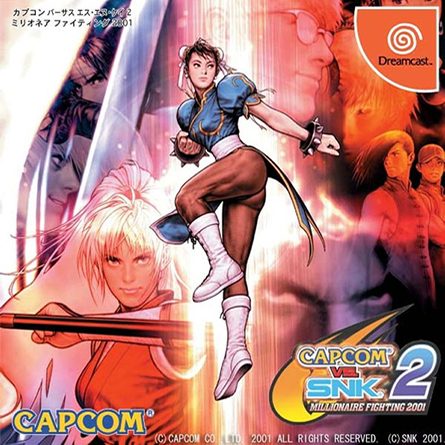

There is no American Dreamcast cover to pair with this one, because there was no American Dreamcast release. The Japanese box, Chun-Li between Ken and Kyo under the Millionaire Fighting 2001 title, is the only Dreamcast box this game ever had. American players met the game on PlayStation 2 instead. This Library shows the gap rather than filling it with another system's box.
THE RECEPTION
35 of 40, and one famous old spriteFamitsu scored the Dreamcast and PlayStation 2 versions 35 of 40 each. In the West, GameSpot gave the Dreamcast version 7.9, the PlayStation 2 version 8.1, and the Xbox EO edition 8.7; the PlayStation 2 version settled at 81 on Metacritic. GameSpot named it a runner up for its Best Fighting Game award, behind the Dreamcast Garou: Mark of the Wolves.
The standing criticism is visual, and it is specific: Capcom redrew much of the cast but carried some sprites forward untouched, and Morrigan's Darkstalkers era sprite, standing next to newly drawn characters, became the famous example. Complex still ranked the game among the finest fighters ever made: 11th in 2011, and 4th among 2D fighting games in 2013.