The History of Diablo
Diablo shipped to retailers at the end of December 1996 and was widely available by January 1997. One town, sixteen randomly generated levels beneath it, and a free online service nobody had tried before. It sold over 2.5 million copies by mid-2001 and effectively founded the action role-playing genre.
THE MAKING
Condor Games, 1993 to 1996David Brevik co-founded Condor Games in 1993 with brothers Erich and Max Schaefer, carrying the idea for Diablo from the start: a roguelike in the line of Moria, NetHack, and Rogue, named for Mount Diablo near his family's home. Most publishers turned the pitch down on the grounds that, in the era's phrase, RPGs were dead. Blizzard's Allen Adham heard it at the 1994 Consumer Electronics Show and came back after Warcraft shipped.
Blizzard's contract, signed in January 1995, came with two requested changes: make it real-time, and give it multiplayer. Brevik resisted the first and the Condor team settled it by vote; he then prototyped the real-time conversion in a single Friday afternoon and had it working by Monday. The fuller story of the design that almost shipped, turn-based, permadeath, and modeled in clay, has its own page in this Library. In 1996 Condor was acquired and renamed Blizzard North.
The multiplayer nearly did not exist. With about six months left, Blizzard's southern studio discovered Diablo had no multiplayer code at all, and sent staff north, Mike O'Brien among them, to build it and wire the game into the new Battle.net service Blizzard South was creating. Matt Uelmen composed the score, six tracks of guitar and dread that reviewers singled out by name.
THE GAME
Tristram, and what is under itBelow the town of Tristram, in the kingdom of Khanduras, a cathedral was built over the buried soulstone of Diablo, the Lord of Terror. The player picks one of three classes, Warrior, Rogue, or Sorcerer, and descends through sixteen procedurally generated levels, church to catacombs to caves to Hell itself, guided by the elder Deckard Cain. The loot system was the revolution: randomized quests, enemies, and magic items meant no two descents stocked the same dungeon.
The ending refuses triumph. The hero pulls the soulstone from Diablo's forehead and, to contain him, drives it into their own. The sequel would confirm what that cost: the Warrior became Diablo's next vessel, the Rogue became Blood Raven, and the Sorcerer became the False Summoner.
HELLFIRE
The expansion Blizzard never wanted, 1997The first Diablo's only expansion, Hellfire (November 1997), was not made by Blizzard North. It was developed by Synergistic Software, a division of Sierra On-Line, after the two companies' shared corporate parent ordered an expansion while Blizzard North moved on to the sequel. Blizzard's conditions, executive-producer credit and final approval, were in Brevik's word summarily ignored, but its hard restrictions held: no Battle.net, no multiplayer, and nothing reserved for Diablo II. The Barbarian class was vetoed; the one new class permitted was the Monk. The full paper trail has its own page in this Library.
The story ends in adoption. In 2019 Blizzard re-released Diablo digitally on GOG.com, and that June it folded Hellfire in as a free add-on, officially adopting the expansion it never wanted, twenty-two years later.
THE EDITIONS
One game, four doors inTHE RECEPTION
Acclaim, with the dissent keptTHE LEGACY
A genre, named by imitationDiablo's three templates, procedural generation, the randomized loot chase, and free matchmaking through Battle.net, became standard equipment for a generation of games, and "Diablo clone" became a genre label in its own right. PC Gamer called it "a nearly flawless gaming experience" as early as 1998; GameSpot later placed it among the greatest games of all time.
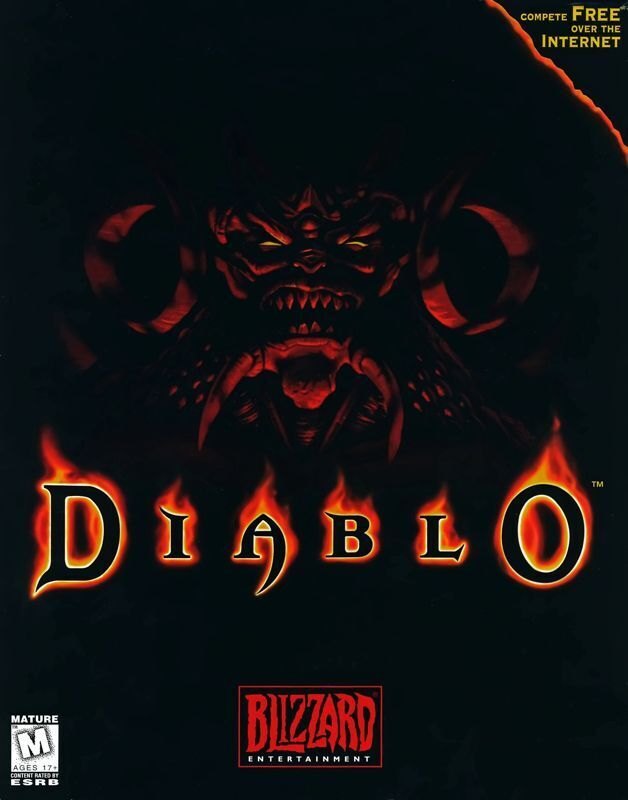
Japan's chapter of the story is the one this Library exists to document: no Japanese PC edition at all, and a PlayStation port whose cover promoted the American PC painting to carry a nation's first Diablo. That release, in full, is here.
THE GAME ON THE SHELF
Diablo · PC