
From the Library: covers, censuses, and editions, documented. Browse the Library →
SOJ Super Butoden · Vintage Fighting Games
← Back to the Fighting Games Gallery

The History of Dragon Ball Z: Super Butoden

The Dragon Ball fighter America never got, years before America knew it wanted it.

Dragon Ball Z: Super Butoden reached the Super Famicom on March 20, 1993: the first fighting game in its franchise, built around a split screen system invented so two fighters could battle across a sky. It sold over a million copies in Japan in two months. In the 16 bit era it was released in France and Spain, and nowhere in the English speaking world. This is the history of the game, and of the gap.

THE COVER

The only box this game ever had
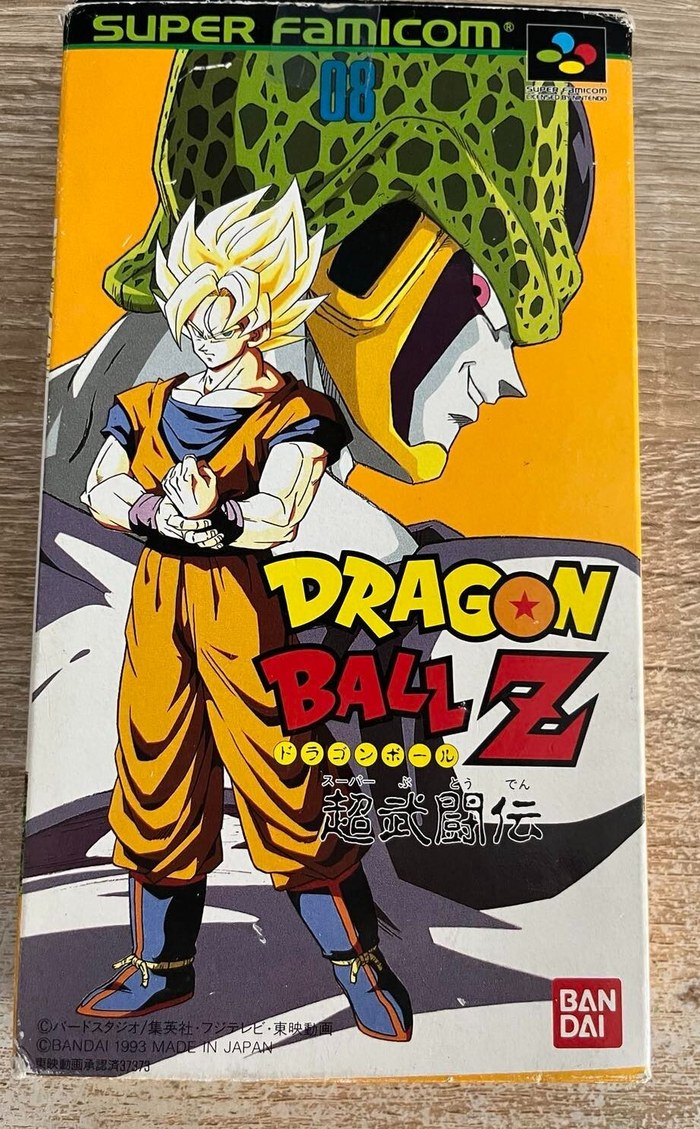
Dragon Ball Z Super Butoden Japanese Super Famicom box art, Goku and Cell
Japan · Super Famicom · 1993
Super Saiyan Goku stands in front of Cell on the Japanese box, under the Super Famicom banner. This is the first Dragon Ball fighting game, and Japan is where it lived. There is no American box beside it, for the reason this shelf exists.

HOW IT WAS MADE

A producer who wanted a fighter
Suzuki chooses the genre
Super Butoden was developed by Tose and produced by Toshihiro Suzuki for Bandai. Due to the popularity of Street Fighter II: The World Warrior, Suzuki stated he chose to work on a fighting game when assigned a new project, because it was his favourite genre. It became the first fighting game in the Dragon Ball franchise, with a story running from the Piccolo Jr. saga to the end of the Cell Games.
The roster and the buttons
Ten playable characters and their transformations, Goku, Piccolo, Vegeta, Frieza, the Androids 20, 18 and 16, Cell, Trunks and Gohan, with one further transformation unlockable by cheat code, fought on a customisable six button scheme. Kenji Yamamoto composed the music; an arranged soundtrack album followed in Japan a week after the game.
The split screen
The game's signature was built for Dragon Ball specifically: when one fighter moves far away across the playfield, the view splits to keep both fighters on screen, with their positions tracked on a radar. Fighters battle on the ground and in the air, and distance itself becomes a weapon, the space Ki blasts need to cross. The official Dragon Ball Super History Book would later call it a "dual screen" system that had never been seen in the fighting games made so far.

THE RELEASE

A hit that stopped at two borders
March 20, 1993
Bandai released Super Butoden in Japan on March 20, 1993. It topped the Famitsu sales charts that month and sold approximately 1.3 million units in its first two months in Japan, reaching lifetime Japanese sales between 1.41 and 1.45 million. A glitter sticker with a hidden technique written on its back was distributed as a Japanese order bonus.
Europe, in French and Spanish
Europe followed on November 30, 1993, where the game was titled simply Dragon Ball Z, in France and Spain, the markets where the Dragon Ball anime was already broadcast. It was never released in North America in the 16 bit era, nor in the United Kingdom or Germany.
The 25 year wait
North America's first official release of the game arrived on September 28, 2018, twenty five years later, as a pre order bonus download for the Nintendo Switch version of Dragon Ball FighterZ. The import era ended as a bonus feature in a game made by the series it had anticipated.

HOW IT WAS RECEIVED

Loved where it was understood
Famitsu · 27 of 40
Famitsu's four reviewers scored it 7, 7, 7 and 6, praising the voice samples, the split screen feature, the ability to avoid special moves by button input, and an auto mode for newcomers. Famimaga readers voted it 23.08 of 30, and the magazine gave it awards for character and originality.
France and Spain · 88 to 92
Consoles Plus scored it 88 percent, Player One 92 percent, and Superjuegos 92 of 100, praising presentation, playability and faithfulness to the manga. Joypad commended the digitised sounds, aerial combat and roster while criticising the visuals and the French translation.
The dissent · Britain
The coolest notices came from a country that never got the game. Super Action called it an "unplayable" Street Fighter II clone and scored it 16 percent; Super Pro scored it 51 percent while calling the split screen novel but cumbersome, and Super Play, at 73 percent, found it original but "hard to access."

WHAT IT LEFT BEHIND

A series, and a gap

Super Butoden spawned a line: Super Butoden 2 within the same year, Super Butoden 3 in 1994, Buyu Retsuden for the Mega Drive, Shin Butoden for the Saturn, and much later Ultimate Butoden and Extreme Butoden. Every one of the 16 bit sequels followed the first game's map, Japan and parts of Europe, none of them America. Producer Toshihiro Suzuki is remembered in the Dragon Ball Super History Book as "Dragon Suzuki," and Toriyama himself was reported in V Jump in April 1993 to be impressed by the game's speed, voice clips and production values.

For American fans of the era, the game was a rumour in import magazines and a cartridge that needed an adaptor and a tolerance for Japanese text. That gap, why it happened and how the split screen worked, is what this shelf keeps.

Why did Super Butoden never come to America?How does the split screen flight system work?
MORE FROM THE FIGHTING GAMES ARCHIVE →
One shelf of eighty-two in the Library. Browse them all →

THE FIRST WORD

New pages and new pieces, first.