
From the Library: covers, censuses, and editions, documented. Browse the Library →
SOJ Fighters Megamix · Vintage Fighting Games
← Back to the Fighting Games Gallery

The History of Fighters Megamix

The crossover AM2 built instead of an arcade game.

Most Sega AM2 games of the era began in arcades. Fighters Megamix did not. Developed by AM2 for the Sega Saturn alone, released in Japan on December 21, 1996 and across the world in 1997, it is a crossover between the studio's two 3D fighting games, Virtua Fighter 2 and Fighting Vipers, with a dozen hidden characters borrowed from across the studio's catalogue.

It was also a preview. Intended as an introduction to Virtua Fighter 3, which was announced for the Saturn but never released there, Megamix carried Virtua Fighter 3 moves and its new dodge into a Saturn game a year before that series continued elsewhere. Critics called the crossover a complete success, and it was hailed on release as one of the Saturn's best games.

THE TWO COVERS

Same standoff, two temperatures
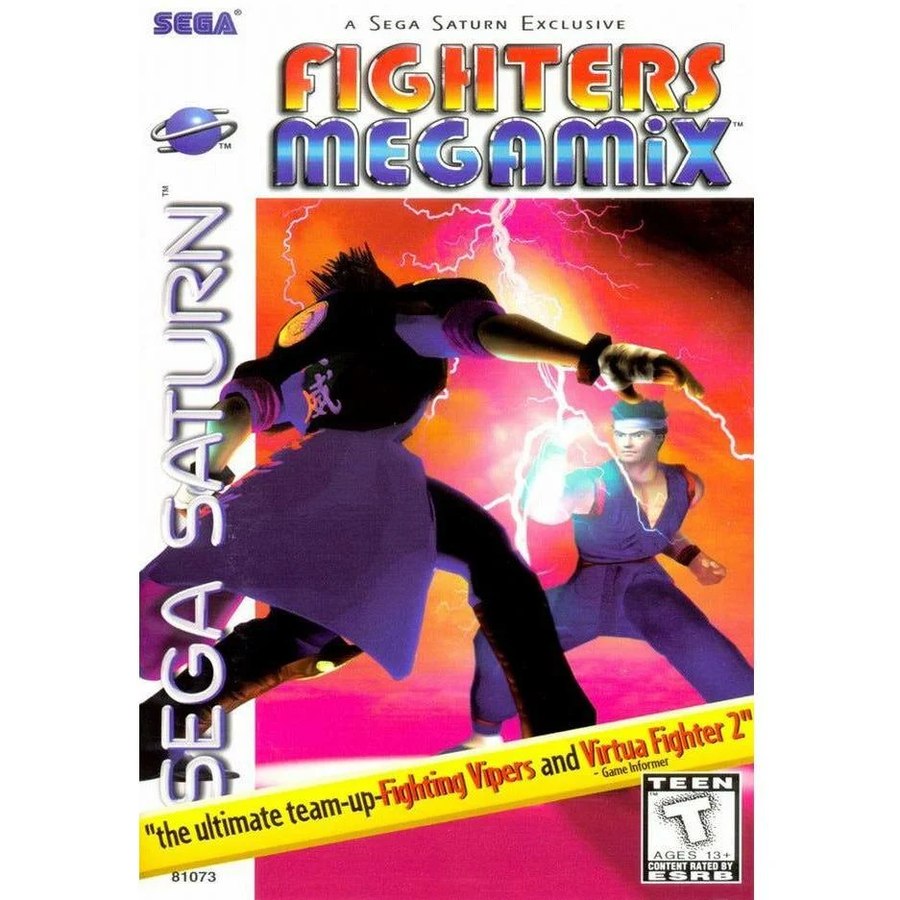
Fighters Megamix American Saturn box art
America · 1997
The American box keeps the same two fighters but turns the background to hot pink and orange, with a banner quoting Game Informer calling it the ultimate team up of Fighting Vipers and Virtua Fighter 2.
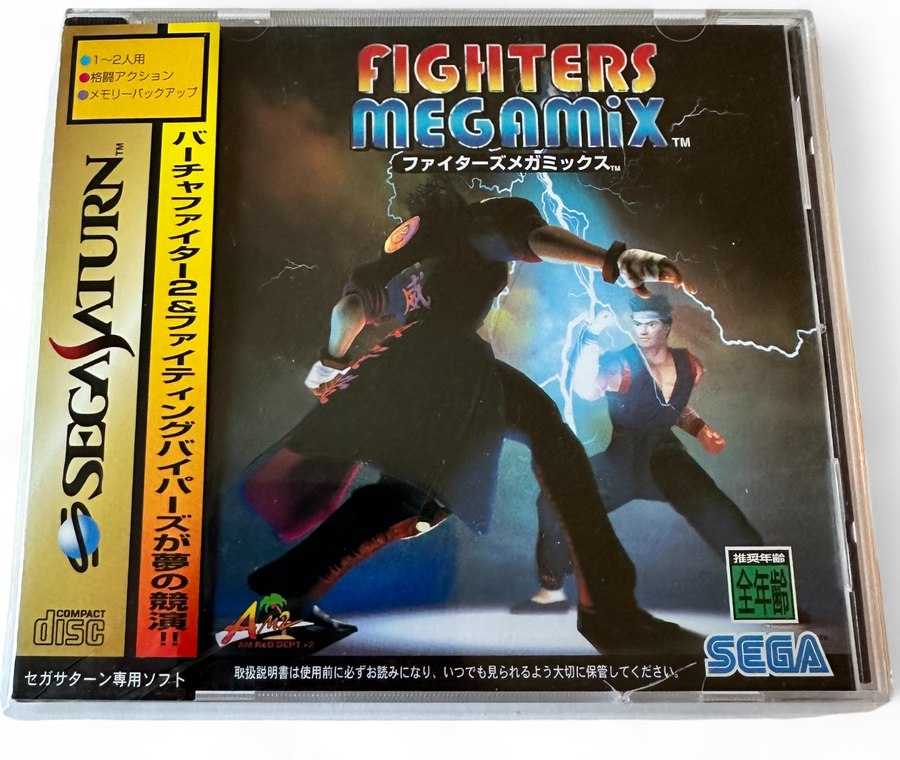
Fighters Megamix Japanese Saturn box art
Japan · 1996
The Japanese box plays the same standoff in near darkness, lit only by the lightning between the two fighters.

HOW IT WAS MADE

A secret project, announced seven weeks before release
The concept
AM2 used the concept popularized by The King of Fighters: characters and styles from different games mixed into one roster. Director Hiroshi Kataoka told Saturn Fan the game was conceived as a new fighting game featuring both casts, not simply the two existing games combined, and described the project to Sega Saturn Magazine as the realisation of a dream for its developers.
The festive brief
Asked what the impetus for the game was, AM2 answered: towards the end of the year we always think about having a festive game for all the users who support the Sega Saturn. The project was kept secret and announced at a press conference on November 6, 1996, less than two months before its Japanese release.
Two systems, reconciled
Players can switch between a Virtua Fighter system and a Fighting Vipers system, differing in knockback distance and recovery. The open rings of Virtua Fighter appear without ring outs, the closed cages of Fighting Vipers alongside them, and the Vipers armor system survives intact, with the Virtua Fighter cast given new moves for breaking armor.
The compression dividend
Fitting Virtua Fighter 2's moves onto one disc had taken months of new compression work the year before. Later advances in compression made fitting Megamix's much larger selection of moves a relatively simple task. AM2 described the game as fairly easy to create.

THE RELEASE

Saturn exclusive, then a handheld shadow
Japan
December 21, 1996, in time for the year end season the game was designed for.
North America and Europe
North America on May 15, 1997, and PAL regions on June 5, 1997. A reduced port for Tiger's Game.com handheld followed in 1998.
What changed overseas
The rendered portraits unlocked through the single player courses were altered between versions. In the American release, the portrait ending the Girls course was replaced with a fully clothed image, and the Tokio portrait from the Smart Guys course was changed. The PAL release retained both Japanese images.

The single player game is built as nine courses, from Novice Trial through themed routes such as Girls, Muscle and Dirty Fighters to Bosses and Secrets, six fights and a hidden final opponent each. Completing courses unlocks the hidden cast, the subject of its own page in this wing. Team battles of up to eight characters per side, survival modes at three, seven and fifteen minutes, and a training mode round out a package built for the home first, because the home was the only place it would ever exist.

HOW IT WAS RECEIVED

Named scores for the Saturn version
Game Informer 9.25/10
The highest score any Saturn game received from the magazine, praising the roster and the variety of move sets.
Next Generation 5/5 and CVG 5/5
Two perfect scores. Sega Saturn Magazine added 95 percent, with Rich Leadbetter calling the game different enough to Virtua Fighter 2, and indeed Virtua Fighter 3, to warrant immediate purchase.
Famitsu 35/40
A strong Japanese score for a game built as a year end celebration. GameSpot gave it 8.6 out of 10 and Electronic Gaming Monthly 8.125, with GameRankings aggregating the Saturn version at 88 percent.

The record describes a game that met with critical acclaim and strong sales, hailed as one of the Saturn's best. Later assessments have been just as warm about the roster and cooler about the balance: putting two casts together without full rebalancing left some fighters, the Fighting Vipers boss Mahler among them, far stronger than others. As a party game rather than a tournament tool, that imbalance became part of its reputation rather than a flaw in it.

WHAT IT LEFT BEHIND

The crossover before the crossover era

Fighters Megamix arrived in 1996, two years before the first Super Smash Bros., with a platform holder's own cast treated as a shared universe: a Virtua Cop officer, two Sonic the Fighters animals, a Mega Drive hero for hire, and a race car, all playable. The idea that a fighting game could be a celebration of a whole studio, rather than one series, is now an industry standard. On the Saturn, AM2 did it first, as a thank you to the console's owners.

It never left the Saturn in its full form, and Virtua Fighter 3 never reached the console it was previewing. Megamix stands as both things at once: the Saturn's crossover party, and the closest the system ever came to its missing sequel.

THE QUESTIONS

Asked of this game
More fighting games →
MORE FROM THE FIGHTING GAMES ARCHIVE →
One shelf of eighty-two in the Library. Browse them all →

THE FIRST WORD

New pages and new pieces, first.