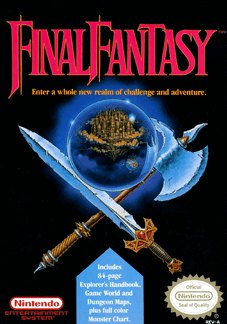
The History of Final Fantasy
Final Fantasy reached the Famicom on December 18, 1987, and the NES in July 1990, published in America by Nintendo. Four Warriors of Light, four darkened crystals, four fiends: a quest assembled from the Western games its makers loved, rebuilt for a console. By March 2003 its versions had sold a combined two million copies, and the series it named has never stopped.
THE MAKING
The A-Team nobody at Square believed inHironobu Sakaguchi had wanted to make a role-playing game for a long time, and Square kept refusing: the company expected low sales. Then Dragon Quest was released and became a hit in Japan, and the company reconsidered. Only three colleagues volunteered for Sakaguchi's project at first, because he was thought of as a rough boss with a run of unsuccessful creations. The team that formed, seven core staff, called the A-Team, knew the company did not believe in them, and the record says that lack of faith is what motivated them to give their best.
The parts were divided with unusual clarity. Akitoshi Kawazu built the battle system on the tabletop Dungeons and Dragons and on Wizardry, importing elemental weaknesses that Japanese RPGs had not used, and argued for letting players choose their own party classes from the start, since he felt the fun of an RPG began when players created their characters. Koichi Ishii brought the idea of the crystals, and performed the project's neatest trick: Sakaguchi rejected his suggestion of illustrator Yoshitaka Amano, then showed Ishii magazine clippings of exactly the art style he wanted, which turned out to be Amano's own work. Iranian American programmer Nasir Gebelli coded the game, and slipped in a sliding puzzle minigame of his own invention, the first in an RPG. Kenji Terada wrote the scenario, Kazuko Shibuya drew the sprites, and Nobuo Uematsu composed, his sixteenth game score.
THE DESIGN
Side view battles and a party that is yoursFinal Fantasy was the first game to put the player's party on the right of the battle screen and the enemies on the left, facing each other, instead of the first person view Dragon Quest used. The four heroes are chosen at the start from six classes, fighter, thief, black belt, and the red, white, and black mages, and the choice is locked for the whole game, which makes the party itself the player's first and largest decision. Later, a class upgrade matures each sprite and widens what they can wield and cast.
Magic is bought, not learned: eight levels of spells, four white and four black per level, three slots per character per level. Under the systems sits a story with a genuine knot in it, a time loop in which the knight Garland, sent 2,000 years into the past, becomes the archdemon Chaos and sends the four fiends forward to send him back, so that he can live forever.
THE EDITIONS
The versions, documentedTHE RECEPTION
Scores, sales, and the dissentThe honest summary is that the first Final Fantasy was admired before it was loved: reviewers saw the ambition and the art, and felt the hours the game demanded. Time has reversed the weighting.
THE LEGACY
What it left behindNearly everything the series is known for is present in embryo: the crystals, the airship, the class system, Uematsu's Prelude taking shape, and a final boss fight against Chaos himself. Square got its hit, Sakaguchi got his genre, and the name chosen under pressure became the most durable in the medium. The naming story, including Sakaguchi's own debunking of the bankruptcy legend, has its own page in this Library.
THE GAME ON THE SHELF
Final Fantasy · NES