
The History of Grandia II
Grandia II (Dreamcast, 2000) is Game Arts' sequel to the Saturn's Grandia, the original of which stands on the Saturn shelf of this Library as a cross door. Built by much of the original staff as a more mature, fully 3D entry, it reviewed at a 90 on Metacritic on the strength of a combat system critics called the most advanced in play. Its Japanese Dreamcast sales, about 184,863 copies, never matched the reviews, and its ports became a cautionary tale told below.
THE MAKING
Game Arts, to August 2000Grandia II was directed by Katsunori Saito and produced by Takeshi Miyaji, the original Grandia's designer, with Toshiyuki Uchida; Noriyuki Iwadare returned to compose. Much of the first game's staff came with them. The design brief was a deliberate turn: a more "mature" product than the bright Saturn original, and the series' first fully 3D graphics. It released in Japan on August 3, 2000, in North America through Ubi Soft on December 5, 2000, and in Europe on February 23, 2001.
THE DESIGN
The IP gaugeCombat runs on the IP gauge: icons for every combatant race along a single track, and acting is a matter of timing on that track. A critical hit landed while an enemy's icon sits in its action phase cancels the enemy's move and knocks the icon back down the gauge, so battles become arguments about tempo, interrupting a boss's spell is a plan rather than a hope, and positioning on the gauge is a resource. Magic comes from Mana Eggs, skills and spells are bought and tuned with Skill and Magic Coins, and the whole system rewards reading the track the way a fighting game player reads frames. IGN's Editor's Choice review called it "arguably the most advanced [battle] system in play today," while finding the story and characters cliché; that split, system over story, is the game's permanent critical shape.
THE EDITIONS
Music in the box, on both sidesRyudo's party, and the sword alone
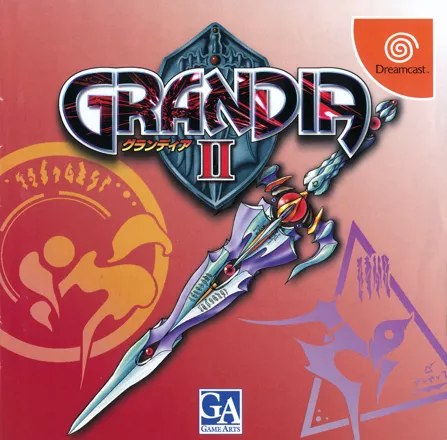
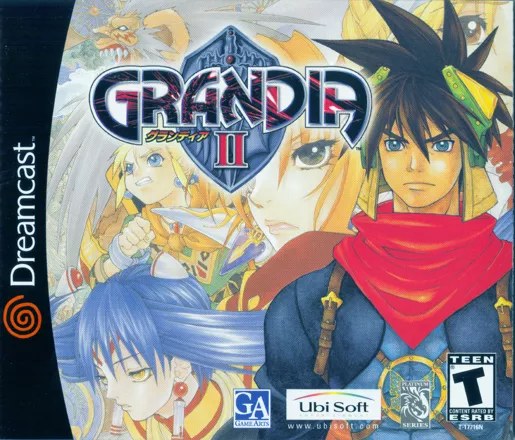
Both launch editions courted music buyers. Japan's Special Package added the Grandia II Melodia CD, and the American edition included a soundtrack disc, Music Selections by Noriyuki Iwadare, twelve tracks chosen from his score. The disc itself is shown in the gallery.
THE RECEPTION
90 on Dreamcast, and the dissent that matteredGamePro gave it a perfect 5 of 5 and EGM a straight run of 9s. Eurogamer's 8 of 10 named the tension precisely, calling it "an incredibly tough game to call," too generic for seasoned players and at the same time "the best RPG on the Dreamcast in Europe." The argument was never about whether Grandia II was good; it was about whether its systems brilliance excused its conventional heart, and reviewers are still on both sides of it.
THE LEGACY
The Dreamcast version is the textGrandia II's afterlife has a clear verdict embedded in it: when the game was finally remastered properly, the developers built from the Dreamcast version, not from the later ports. The 2002 conversions stand as the era's standard warning about what a careless port does to a reputation, and the 2015 and 2019 restorations as the correction. For collectors the shape is simple: the Dreamcast original is not the old version of this game. It is the authoritative one.