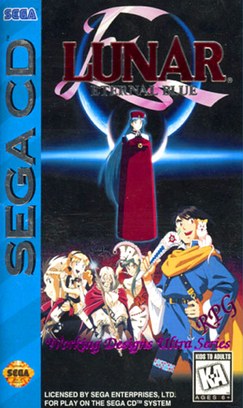
The History of Lunar: Eternal Blue
Lunar: Eternal Blue (Sega CD, Japan December 22, 1994; North America September 1995) returns to Lunar a thousand years later: Hiro, an explorer, meets Lucia, a girl from the Blue Star, as the god Zophar moves to destroy and remake the world. Developed by Game Arts and Studio Alex, directed by Yōichi Miyaji and Hiroyuki Koyama, written by Kei Shigema with Takashi Hino and Toshio Akashi, characters again by Toshiyuki Kubooka, music by Noriyuki Iwadare.
THE MAKING
Three years, $2.5 million, twice the scriptEternal Blue took three years and over US$2.5 million to produce, with twice the dialogue of its predecessor. The original plan, set a few years after The Silver Star with an older returning cast, was discarded so the new cast would not lose focus. Shigema's stated seed for the oppressive god at the story's center is documented (Tier 1, from the Lunar I & II Official Design Material Collection as carried in the reference record): the image of Sun Wukong unable to escape the Buddha's palm in Journey to the West, the arrogance of a god saying, in the end, you pathetic humans are in my hands.
Where The Silver Star carried about ten minutes of partially voiced animation, Eternal Blue carries nearly fifty minutes of fully voiced video, and over an hour and a half of recorded speech against the first game's fifteen minutes of voice. The Japanese release machinery matched the ambition: a Prelude drama album before launch, a Premium CD packed in, and the two volume Lunatic Parade drama set after.
THE DESIGN
Working Designs, hands on the machineryThe American edition, again under Victor Ireland, kept the house style, pop culture references, wordplay, and fourth wall breaks that are not in the Japanese script, and went further into the game itself. Documented changes: battle difficulty altered where the Japanese version was judged near impossible; the English ending theme kept Lucia's Theme with Jennifer Stigile singing; an original track, the Star Dragon Theme, exists only in the English release; and the save system was given a cost. In the North American version, recording progress spends the magic experience points earned in battle. Ireland's stated reason is on the record: the team wanted to make the player think about where and when to save without making it too burdensome. The combat interface also learned to remember the player's last selected action.
Whether those interventions were improvements or intrusions is the longest running argument in the series' Western life, and the review record below shows it starting immediately. This Library's position is documentation: the changes, the reasons given at the time, and both verdicts are printed across the two Lunar histories and the flagship question page.
THE EDITIONS
The last big Sega CD epic, then the remakeTHE RECEPTION
Praised, with the jokes on trialThe translation fight, in the open: GameFan's preview called the English script ingeniously written, and Working Designs quoted the line in print ads. GameFan's review then questioned the frequent jokes and lewd quips standing where the Japanese narrative stood, which Ireland called a complete about face. The magazine still scored the game 91 percent and called it one of the greatest epics ever programmed, praising the non joke laden majority of the script as excellent. Sales closed the era: second highest selling Sega CD game in Japan and third worldwide, behind its own predecessor, with North American sales low against the new 32-bit machines, a shortfall Ireland attributed to the market's declared death of the Sega CD.
THE LEGACY
The peak and the argument, in one boxRetro Gamer counts Eternal Blue among the top ten Mega CD games. Its legacy runs on two rails that never separate: it is the technical and narrative peak of the Sega CD, and it is the fullest surviving document of the most interventionist localization practice in the industry's history. Collectors price both rails; the Working Designs editions are collected as Working Designs editions, not despite the changes but with them itemized.
THE GAME ON THE SHELF
Lunar: Eternal Blue · Sega CD