
From the Library: covers, censuses, and editions, documented. Browse the Library →
SOJ Lunar · The Question
← Back to the Library

What did Working Designs change in Lunar?

More than the words: names, jokes, songs, sequences, difficulty, and the price of saving.

The verdict: Working Designs' Lunar editions (The Silver Star, 1993; Eternal Blue, 1995) are not straight translations of Game Arts' Japanese games. The changes are documented in unusual detail, most of them from the reference record of the two games themselves, and they fall into six kinds. This page lists them without taking the side that three decades of argument have not settled.

THE SIX KINDS OF CHANGE

Itemized from the two games' records
Names and censorship
Character names changed across both casts (Killy to Kyle, Faidy to Quark, Temzin to Tempest, Pilya to Fresca). Mel's epithet Hell Mel became Deadly Mel for censorship. One addition reads the other way: the translation says Mel founded Meribia where the Japanese says he governs it.
Humor, injected
Jokes and pop culture references with no Japanese counterpart, including the lemon jello line in The Silver Star and, in Eternal Blue, wordplay and fourth wall breaks throughout, plus jokes and double entendres added to the cast's speech to make the game more comical.
Sequences, added
New material at Victor Ireland's request, most famously Alex playing his harp to awaken Luna at the end of The Silver Star, added in collaboration with the Japanese team.
Music, rewritten
The Silver Star's English opening kept the song Lunar with new lyrics by Ireland, who wanted urgency over a lovey dovey tone. Eternal Blue's English edition contains an original track, the Star Dragon Theme, that does not exist in the Japanese release.
Difficulty, rebalanced
In Eternal Blue, battle difficulty was altered where the Japanese version was found near impossible, working with Game Arts staff. The interface also gained memory of the player's last combat command.
Saving, priced
Eternal Blue's North American version charges magic experience points, earned in battle, to record progress. Ireland's stated reason: to make the player think about where and when to save without making it too burdensome.

THE ARGUMENT, BOTH SIDES ON THE RECORD

Praise and prosecution, from the same magazines

GamePro gave The Silver Star particular merit for its translation and called it one of the best RPGs on any Sega system; Retro Gamer later praised the fantastic localization. The prosecution's best documented exhibit is GameFan's own reversal on Eternal Blue: its preview called the script ingeniously written, a line Working Designs quoted in print advertising; its review then questioned the frequent jokes and lewd quips in place of the original Japanese narrative. Ireland called the review a complete about face. GameFan still scored the game 91 percent and called the non joke laden majority of the script excellent. Both verdicts were printed by the same magazine within one release cycle, which is why this Library presents the record rather than a ruling.

WHY IT MATTERS TO A COLLECTOR

The changes are the edition

A Working Designs Lunar is a distinct edition, not a regional printing of the Japanese game: different text, different balance, a different save economy, an extra sequence, extra music, and in The Silver Star's case seven collectible disc art variants and an embossed manual. That is also why the modern fan projects that undo the gameplay changes exist, and why the 2025 Remastered Collection's handling of this script was news in itself. Price and collect the American editions as their own artifacts, which is what they are.

ONE OF THE TWO

Lunar: Eternal Blue
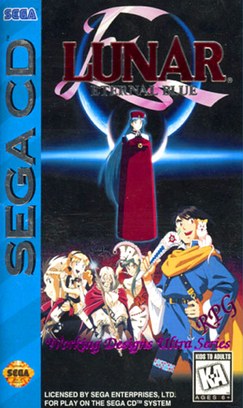
Lunar Eternal Blue American Sega CD box art
Lunar: Eternal Blue · America · Sega CD
The American Sega CD box for Eternal Blue, one of the two Working Designs editions whose changes this page catalogues.
The History of Lunar: The Silver StarThe History of Lunar: Eternal BlueThe Gallery
MORE FROM THE RPG: GENESIS ARCHIVE →
One shelf of eighty-two in the Library. Browse them all →

THE FIRST WORD

New pages and new pieces, first.