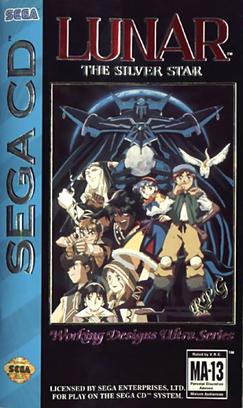
The History of Lunar: The Silver Star
Lunar: The Silver Star (Mega-CD, Japan June 26, 1992; Sega CD, North America December 1993) was built by Game Arts with its subsidiary Studio Alex, named for this game's hero, and localized by Working Designs. Alex of Burg dreams of following Dragonmaster Dyne; the road runs through four dragons to the Magic Emperor Ghaleon. The story is by novelist Kei Shigema, the characters by animator Toshiyuki Kubooka, the music by Noriyuki Iwadare, Hiroshi Fujioka, Isao Mizoguchi, and Yoshiaki Kubodera.
THE MAKING
Stories, but no story tellingGame Arts set out, in the record's words, to make a different kind of RPG. Shigema was hired to break away from hum drum model games that had stories but no story telling, and the Sega CD's video playback was the delivery system: animated sequences with voice overs carrying the plot, on hardware Game Arts had mostly used for side scrollers and shooters before this. Time pressure was real: nearly one third of the project was cut before release.
The English edition was Working Designs' biggest project yet. Vice president and chief writer Victor Ireland worked with the Japanese team directly, added sequences at his request, most famously Alex playing his harp to wake Luna in the finale, and finished a script of nearly four megabytes in an eight week marathon. The packaging became a collector story of its own: an embossed manual and seven different disc art stamps, produced deliberately to increase collection value. The discs in any given copy are a variant lottery, and the variant is part of the artifact.
THE DESIGN
A northern world, told in cutscenesThe world was given a deliberate northern feel, its towns modeled on Russia and medieval Europe, so the characters could plausibly wear more clothing: a small, documented design decision that gives Lunar its visual temperature. Battles are turn based with positioning: characters must be in range to strike, and Nall, the flying companion, reads enemy strength before fights begin.
The localization is a design layer of its own, and this Library documents it precisely. Names changed across the cast (Killy became Kyle, Faidy became Quark, Temzin became Tempest); Mel's Japanese epithet Hell Mel became Deadly Mel for censorship; the translation added that Mel founded Meribia where the original says only that he governs it; and Working Designs injected its own humor throughout, down to lines like asking whether you have ever tried swimming in lemon jello, plus references to American commercials, celebrities, and products that do not exist in the Japanese script. The English opening song kept the melody's title, Lunar, with new lyrics by Ireland, who wanted urgency instead of a lovey dovey tone.
THE EDITIONS
One Sega CD game, three remakesTHE RECEPTION
Japan's Mega-CD hit, America's argumentFamitsu scored it 26 of 40 in Japan, the coolest major number on either side of the Pacific. Retro Gamer later placed it among the top ten Mega-CD games and singled out its fantastic localization, which is the honest summary of the Western record: the translation was both the game's loudest praise and, for script purists then and since, its standing controversy. What Working Designs changed, across both Lunar games, is documented on the Library's flagship question page for this era.
THE LEGACY
The series standard, set first tryThe Silver Star founded the series, fixed its themes, and proved in both markets that a CD RPG could sell hardware. Its Mega Drive readers' poll run in Megadrive Beep, seventeen straight months as the number one Mega Drive RPG before Shining Force II displaced it, is the kind of record that only exists when a game owns its machine.
THE GAME ON THE SHELF
Lunar: The Silver Star · Sega CD