
The History of Marvel vs. Capcom 2
Marvel vs. Capcom 2: New Age of Heroes (arcade and Dreamcast, 2000) is the summit of Capcom's Marvel line: 56 playable characters, teams of three, 2D sprites over 3D stages. Its Dreamcast version scored 90 on Metacritic, became the version later ports were built from, and spent the years after its 2013 digital delisting as the only reliable way to own the game. This shelf also keeps the PlayStation original's pages; this is the Dreamcast sequel, and a different story.
THE MAKING
Off the CPS boards, onto NAOMIMarvel vs. Capcom 2: New Age of Heroes was announced on December 1, 1999, and it broke the series' hardware line: after years on the CPS and CPS II boards, this was the first entry built for Sega's NAOMI arcade system. The change shows on screen. The fighters remain hand drawn 2D sprites, but for the first time they fight in front of fully 3D backgrounds, the 2.5D look that defines the game.
Under producer Yoshihiro Sudou, with art direction associated with Bengus and music by Tetsuya Shibata and Mitsuhiko Takano, Capcom also streamlined the fighting itself: teams grew from two to three, the Variable Assist system returned with three assist types per character, a snapback attack could force an opponent's character out, and the controls settled on four attack buttons plus two assist buttons. Why the roster reached 56 characters is its own story: the accumulated roster.
THE RELEASE
One week from arcade to DreamcastThe arcade game launched in Japan on March 23, 2000. The Dreamcast version followed on March 30, 2000 in Japan, June 29, 2000 in North America, and July 16, 2000 in Europe. Because NAOMI is Dreamcast based hardware, the home version arrived essentially intact, a week behind the arcade. The Japanese release went further and wired the two together: points earned on the Dreamcast VMU could be spent in the arcade and back, and Japan's Match Service put the Dreamcast version online.
The unlock economy ran through a Secret Factor shop: the arcade cabinet unlocked characters over time, the console versions replaced that clock with points earned in play. The later PlayStation 2 and Xbox ports (2002 to 2003) arrived in limited numbers, and then nothing for years, for reasons of licensing set out below.
THE COVERS
Japan and America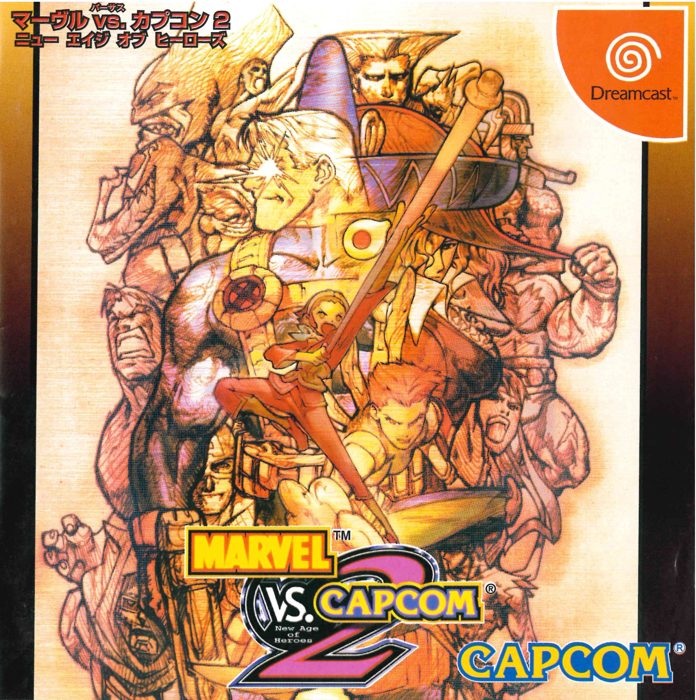
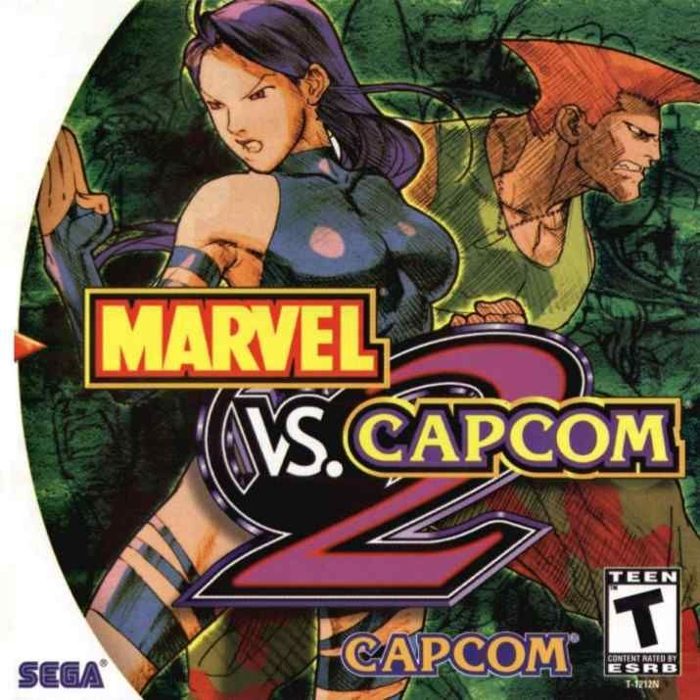
The Japanese box is a single inked illustration of the whole crossover crowd, sepia and dense, with Cable at its centre. The American box trades the crowd for impact: Psylocke and Guile in full colour, mid lunge. Both are honest about the game, a roster event, but Japan sells the archive and America sells the fight.
THE RECEPTION
A 90, and a soundtrack nobody defendsThe Dreamcast version settled at 90 on Metacritic and about 90 percent on GameRankings, with IGN at 9.3, GameSpot at 8.4, GameRevolution at B+, and Famitsu at 34 of 40. Next Generation's Blake Fischer called it "the best 2D fighting experience available on a console". Complex later named it the best 2D fighting game of all, in both 2011 and 2013.
The one count against it, then and now, is the music: the smooth jazz score was widely disliked, IGN's Jeremy Dunham calling it "plain god awful" in print. The game survived its soundtrack the way it survived everything else, on the strength of the roster and the fight.
LOST AND FOUND
Delisted in 2013, back in 2024After this game, Capcom's Marvel licence lapsed and the series slept for a decade, until Marvel vs. Capcom 3 in 2011. The downloadable revival of MvC2 on PlayStation 3 and Xbox 360, built in 2009 by Backbone Entertainment on the Dreamcast version's own code base, sold strongly, and then vanished: Capcom announced the delisting on December 15, 2013, and the game left the PlayStation Store that month and Xbox Live Arcade on December 26, 2013, when the licence apparently expired. The iOS version went with it.
For eleven years the discs were the game. The fan campaign under the banner #FREEMVC2 ran from 2021, an Arcade1Up cabinet followed in 2022, and in September 2024 the game finally returned in the Marvel vs. Capcom Fighting Collection. Why the Dreamcast disc spent that whole era as the reference version is the second question on this shelf: the definitive version.