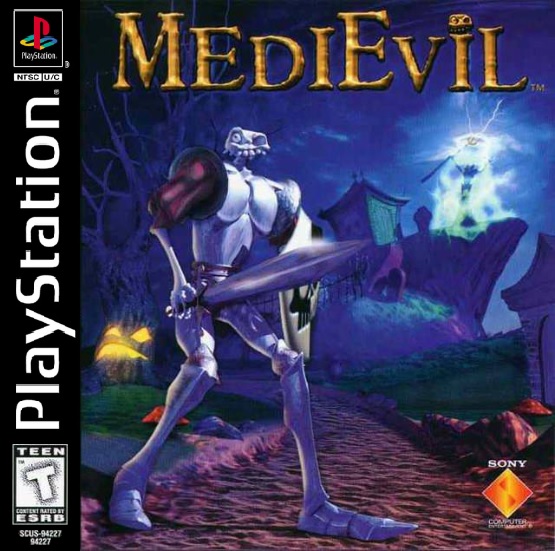
The History of MediEvil
MediEvil (PlayStation, 1998) is the story of Sir Daniel Fortesque, a knight celebrated as the hero who slew the sorcerer Zarok, and a fraud: in life, Dan fell to the first arrow of the battle he never fought. A century later Zarok returned, raised the dead of Gallowmere, and raised Dan by accident with them. Built by a small British studio that Sony bought mid-development, the game sold over 800,000 copies by November 1999 and became one of the PlayStation's defining originals.
THE MAKING
Millennium Interactive, 1995 to 1998Development began in 1995 at Millennium Interactive, a small independent studio in Great Shelford, England. Chris Sorrell, previously known for the James Pond series, created the concept and served as creative director, a chance he later said management gave him after a difficult stretch making edutainment titles: his reward was, in his words, the chance of making his dream game.
The studio was in trouble while it built it. The team was brand new to 3D games of this scale, and the project was being pitched for its life almost from day one, first aimed at Windows 95 and the Sega Saturn as well as the PlayStation. Sony's managers loved the demo. Sony signed the game as a PlayStation exclusive, then bought the studio outright in July 1997, and Millennium became SCEE Cambridge Studio, Sony's second studio in the United Kingdom.
Late in development Sony asked for one more thing: support for the then new PlayStation analogue controller. Sorrell called that request a particularly fortuitous event, because it let the team capture far more fluid and intuitive control than the digital pad allowed.
THE DESIGN
Sorrell's pitch, Wilson's eye, Pond's backstoryThe concept is on record in Sorrell's own words (Tier 1, from Sony's own PlayStation.Blog interview): the first design proposal, under the working title Dead Man Dan, described a fusion of Capcom's Ghouls 'n Ghosts with the art style of Tim Burton, especially The Nightmare Before Christmas. Lead artist Jason Wilson shared the taste and pushed the look toward 1920s German Expressionism, citing The Cabinet of Dr. Caligari, Nosferatu, and Metropolis, while the game itself grew from an arcade design toward a Zelda-like adventure.
Dan's failure was designed, not accidental. Working with script doctor Martin Pond, the team settled on a lead who had been a pompous failure in life, whose resurrection was his one shot at redemption. Composers Paul Arnold and Andrew Barnabas (Bob and Barn) built the score on synthesizers simulating an orchestra and organ, after Sorrell asked them for a Danny Elfman style score in the vein of Beetlejuice and Batman Returns. One resident of Dan's skull never made the cut: Morten the earthworm, who lived in his empty eye socket.
The Library keeps the full influence record, stated versus guessed, on its own page: What inspired MediEvil?
THE EDITIONS
One game, three regions, one remakeTHE RECEPTION
Warmth, with the camera kept in the recordThe praise ran to the art, the humour, and the personality; the dissent ran, then as now, to the controls and the cumbersome camera, the tax a brand new 3D team paid in 1998. The sales split tells the regional story plainly: over 800,000 copies worldwide by November 1, 1999, a Sony plaque for 250,000 sold in a single fiscal year, and a Japanese edition that never reached the Famitsu top 300 for 1999, which puts it likely under 38,000 copies at home. Europe adopted Dan. Japan, offered a skeleton for a hero, mostly did not, and the Library's Japan page tells that story in full.
THE LEGACY
The knight who keeps getting raisedA sequel followed in 2000, a PSP reimagining (MediEvil: Resurrection) in 2005, and a long digital afterlife: PlayStation Network in 2006, and a fresh PlayStation 4 and 5 re-release in April 2024 with trophy support. Dan also turned up as a playable fighter in PlayStation All-Stars Battle Royale, the surest sign of which 1998 characters Sony counted as family.
The 2019 remake closed the circle the original release opened: the game Japan had waited eight months for in 1999 arrived there six days after the West in 2019. Gallowmere's fraud of a hero had become, twenty years on, a piece of PlayStation heritage worth rebuilding from the grave up.
THE GAME ON THE SHELF
MediEvil · PlayStation