
The History of Mega Man X
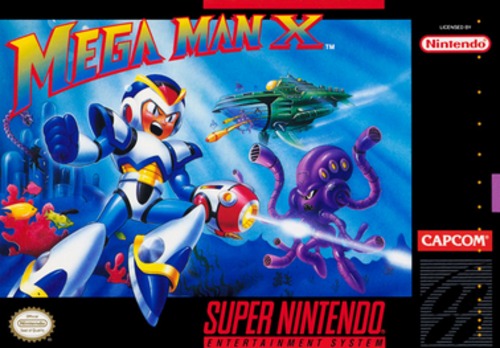
Mega Man X (Super NES, 1993; Rockman X in Japan) moved the series a century forward. Dr. Cain unseals X, the last creation of Dr. Light, a robot built with free will and sealed away for a 30 year diagnostic that ran for 100. Cain copies the design into mass produced Reploids; some go rogue and are branded Mavericks; the Maverick Hunters police them; and the Hunters' own leader, Sigma, defects and calls for the extinction of humanity. X, guilt ridden at having made the Reploid race possible, fights beside the only Hunter who stayed loyal: Zero. The game sold 1.165 million copies on the SNES and is now routinely listed among the greatest games ever made.
THE MAKING
Capcom, 1993The team was the NES Mega Man team, working under producer Tokuro Fujiwara, with design by Yoshinori Takenaka, Keiji Inafune, Sho Tsuge, and Masayoshi Kurokawa. Lead artist Keiji Inafune (credited as a planner, as Inemuryar) recalled that development required a lot of brainstorming: the goal was to branch out from the original games while keeping their fundamentals.
One quiet reversal shaped the look. In the classic series Inafune designed the protagonist and his protege Hayato Kaji handled the supporting cast; for X they swapped roles. Kaji (credited as Rippa H.K) illustrated X himself, and struggled at first: the Super NES palette gave him far more freedom, and far more colors, than the NES ever had. Inafune and Kaji designed X simultaneously, each attaching different armor pieces. The armor parts idea came from the era: role playing games were becoming extremely popular, and Inafune felt Mega Man had always been about a hero earning his defeated enemies' abilities, so the armor supplemented that formula with RPG style growth.
Inafune's own design was not X at all. He created Zero intending him as the game's main, playable protagonist. "When the X series came out, I really wanted to redesign Mega Man," he explained. "I wanted a totally different Mega Man. I'm a designer, a creator; I wanted something new. I didn't want to use the same old Mega Man." Fearing a negative reaction from fans, the team reduced Zero to a secondary role. The sophistication they wanted came through him anyway: Zero's hardcore personality, and a villain unlike Dr. Wily. Wily, in Inafune's words, had "a side to him you couldn't really hate"; Sigma was written as a once good character suffering an unforeseen error that made him completely evil.
The tradition of bosses named with a "Man" suffix ended here. The eight Mavericks are anthropomorphic animals, divided among three illustrators: Inafune drew Storm Eagle and Chill Penguin; Kaji drew Spark Mandrill, Launch Octopus, and Sting Chameleon; Kazunori Tazaki (credited as Ikki) drew Flame Mammoth, Armored Armadillo, and Boomer Kuwanger. New hire Tatsuya Yoshikawa designed the minor enemies. Two preview allies, RX and RY, were cut before release.
THE GAME
Dash, walls, and a borrowed fireballThe structure is the classic one, eight stages in any order, each boss yielding his weapon, but X moves like a new character: he dashes, scales and slides down almost any wall, and finds Dr. Light's capsules, which upgrade his legs, armor, helmet, and buster piece by piece. Clearing one stage can change another: finish Storm Eagle's aircraft carrier and Spark Mandrill's power plant suffers electrical outages that remove hazards. Hidden Heart Tanks and Sub Tanks reward the same curiosity.
Meet one famous condition set and a secret capsule teaches X the Hadouken, the fireball of Capcom's Street Fighter series, a crossover hiding inside the flagship of a different franchise.
THE MUSIC
One composer, four rescuersThe score is credited to Capcom's Alph Lyla group, but it began as one man's assignment. Setsuo Yamamoto (credited as Setsuo) was initially the sole composer and wrote the vast majority of the soundtrack. Late in production four colleagues were brought in to help finish it, each taking a track or two: Yuki Iwai wrote Chill Penguin, Toshihiko Horiyama the password screen, Yuko Takehara Boomer Kuwanger, and Makoto Tomozawa two, Storm Eagle and Spark Mandrill. Iwai and Horiyama went on to compose Mega Man X2 and Mega Man X4. Sony Records' Japanese division published a ten track arranged album on March 9, 1994. The full story is on this Library's music page, linked below.
THE EDITIONS
One cartridge, a shelf of returnsTHE RECEPTION
Acclaim, with the dissent keptTHE LEGACY
Seven sequels and a spinoffThe 1.165 million SNES sales made Mega Man X the 41st best selling Capcom game of all time as of the 2001 count. The rankings have accumulated since: Nintendo Power placed it 58th in its 100 best Nintendo games (1997) and 11th best SNES game (2008); GamesRadar and ScrewAttack each ranked it the eighth best SNES game; GamePro the eighth greatest 16 bit game; IGN the twelfth best SNES game in 2011; Game Informer the 120th best game of all time. GamesRadar's Brett Elston called it "a total reinvention of the series, a perfectly executed update."
Seven direct sequels followed, plus the Xtreme pair and Command Mission. The largest consequence stands beside X on the box of everything after: Zero's immense popularity launched the Mega Man Zero series in 2002. One small confusion also proved durable: on release, many gamers mistook the X for the Roman numeral 10.