
The History of Mega Man X3
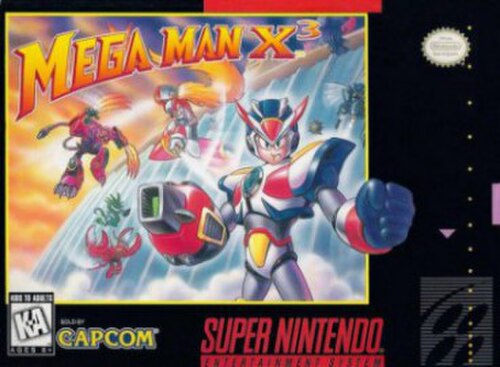
Mega Man X3 (Super NES, 1995; Rockman X3 in Japan) begins with peace apparently won by science: Dr. Doppler's technology has neutralized the Mavericks, and the reformed Reploids have built a utopia, Dopple Town, around him. When the utopia revolts and attacks Hunter headquarters, X and Zero ride out again, and Doppler, once captured, reveals the truth: Sigma survives as a computer virus, and the utopia was his new body under construction.
THE MAKING
Capcom designs, outsiders buildBy X3, Keiji Inafune had transitioned from artist to director, producer, and writer. Starting with X2 he had wanted the computer virus as a plot device, something he considered more interesting than a tangible villain. His duties now included merchandising the game into toys and trading cards. Capcom kept the scenario, character designs, and artwork in house, but subcontracted much of the actual game design to Minakuchi Engineering, the studio behind most of the Game Boy Mega Man games and The Wily Wars. Inafune recalled experiencing "psychological turmoil" over letting outsiders handle the development.
His own illustrations for X3 were exactly three characters: X, Zero, and Vile. Of Zero he admitted being very "possessive", having a vested interest since the character's creation. The other bosses and enemies were divided among Hayato Kaji, Tatsuya Yoshikawa, Shinsuke Komaki, and Kazushi Itou. The Cx4 chip returned for the wireframe effects. The soundtrack was composed by freelancer Kinuyo Yamashita, working for Minakuchi rather than Capcom; the 32 bit editions added two J-pop vocal songs by Kotono Shibuya, the opening "One More Time" and the ending "I'm Believer".
ZERO, PLAYABLE
One life, no second chancesX3 is the first game in the series where Zero can be played, in a deliberately limited form: he can be called in to take X's place in nearly any stage, but he cannot collect armor parts or power ups and cannot fight the bosses, with one exception that opens the way to a secret weapon for X. The limit has teeth: if Zero is defeated even once, he cannot be called again for the rest of the game. The ending respects the same fragility: if Zero stands uninjured at the climax, he delivers Doppler's antivirus on his sabre; if he was hurt, Doppler sacrifices his own body as the antivirus instead.