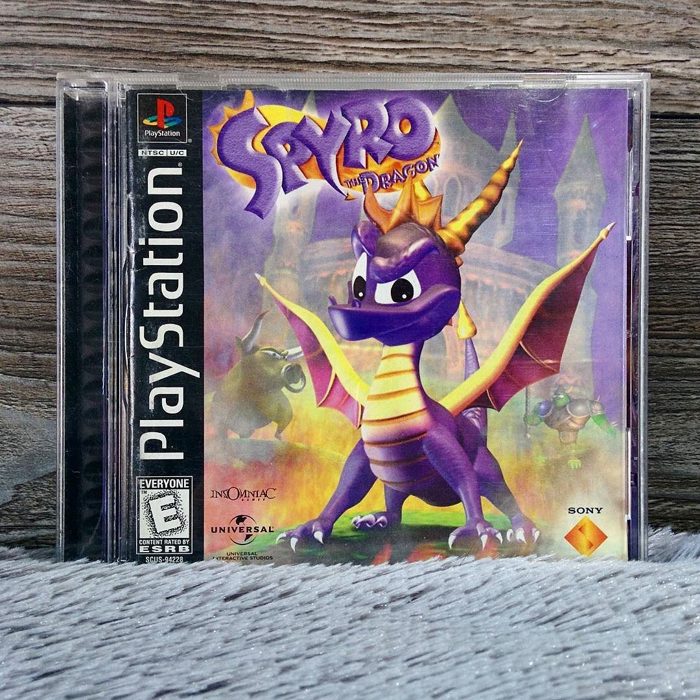
The History of Spyro the Dragon
Spyro the Dragon (PlayStation, 1998) was Insomniac Games' second game and the PlayStation's answer to Super Mario 64: an open 3D platformer whose levels stretch to the horizon with no fog and no pop-in, drawn by an engine built for exactly that trick. It sold nearly five million copies, made Spyro a PlayStation mascot beside Crash Bandicoot, and then, in Japan, became a different and stranger game. That rebuild has its own page in this Library; this page is the whole story around it.
THE MAKING
Insomniac, 1997 to 1998Insomniac's first game, the shooter Disruptor (1996), sold poorly but reviewed well enough that Universal Interactive encouraged a second project. Artist Craig Stitt suggested a game about a dragon. The first tone was darker, influenced in part by the film DragonHeart, until producer Mark Cerny steered the team toward mass appeal: the PlayStation's audience was getting younger, and its children's catalogue was thin beside the Nintendo 64's. The game turned whimsical.
The hero nearly shipped under other names. He was "Pete" until the resemblance to Disney's Pete's Dragon raised copyright worries, then "Pyro," judged too mature, before the team settled on Spyro. Character designer Charles Zembillas, who had worked on Crash Bandicoot, drew him green at first; the developers changed him to purple so he would not blend into the grass. Insomniac worked across the hall from Naughty Dog, and the two studios played each other's early builds and shared technology; a demo of Crash Bandicoot: Warped hides inside Spyro, and vice versa.
THE DESIGN
An engine for distance, a drummer for musicProducer Michael John cited Super Mario 64 as an influence, its long views, landmarks, and hub worlds, and Insomniac deliberately packed in more collectibles. The technical heart was a panoramic engine by programmer Alex Hastings: every level exists in two versions, a detailed render and a simple textureless one, and distant objects are drawn from the simple version, so a player gliding from a peak can see across a whole world that the PlayStation's memory could never hold at full detail. It was one of the first uses of shifting levels of detail in a game of this kind.
The camera nearly sank it. The first camera chased directly behind Spyro, and its rapid tilts made playtesters nauseous; Matt Whiting, a NASA engineer who specialised in flight controls, helped rework the movement and camera until the motion steadied. That detail matters to this Library: the same sickness problem, met again in Japan, is why the Japanese edition was rebuilt, as the Japanese version page documents in full.
Stewart Copeland, the Police's drummer, composed the score by playing early builds of each level, cheats and all, writing roughly three songs a day and polishing them the next. Carlos Alazraqui voiced Spyro, aiming, he said, for "a kid at camp that everybody likes."
THE EDITIONS
West first, Japan rebuiltTHE RECEPTION
Praise, with the dissent keptSales started slowly, then the 1998 holiday season carried the game: third best seller in the UK in the last week of November, one million copies in North America by December 1999, and nearly five million worldwide in the end. Spyro stood as a PlayStation mascot next to Crash, and Insomniac's rendering system went on to be used across later 3D games.
THE GAME ON THE SHELF
Spyro the Dragon · PlayStation