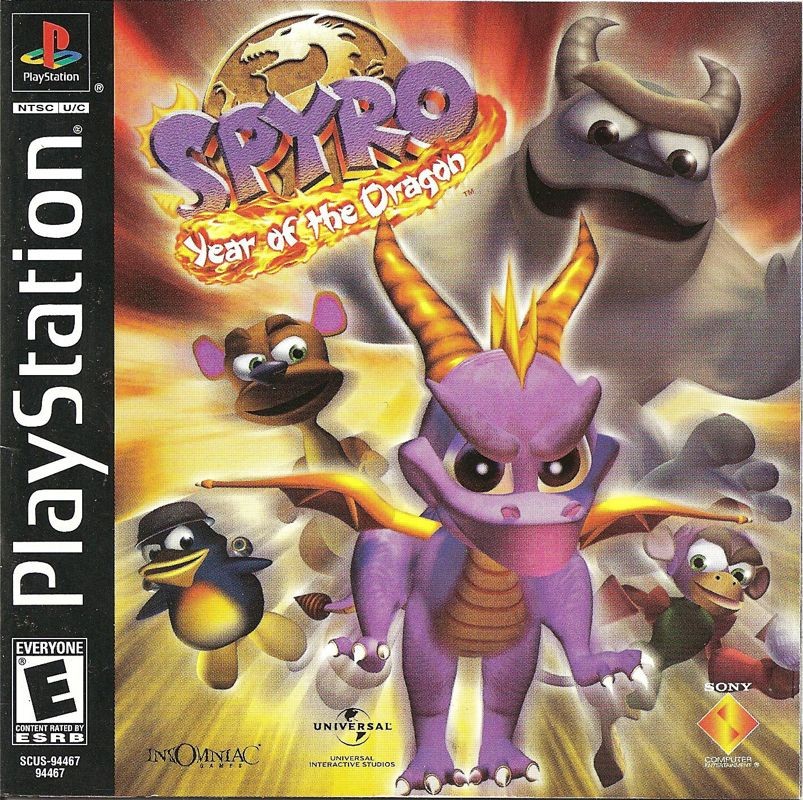
The History of Spyro: Year of the Dragon
Spyro: Year of the Dragon (PlayStation, 2000) is the third Insomniac Spyro and the studio's last: the biggest of the trilogy, with new playable characters, an anti-piracy system that held for two months, and the series' best reviews, a 91 on Metacritic. It sold more than 3.2 million copies. It is also the only game in the trilogy with no Japanese edition at all, the end of the line for the Japanese rebuilds the Library documents on this shelf.
THE MAKING
Ten and a half months, all stops outDevelopment ran about ten and a half months, from November 1999 to September 2000. The title names its year: 2000 was the Year of the Dragon in the Chinese zodiac. Ted Price described the goal as "pulling out all the stops," answering fan feedback that praised the previous games' depth and variety. Levels grew larger than Spyro 2's, with minigame areas loading separately so players would not lose their way.
The headline addition is the critters: playable characters freed by paying Moneybags, each with their own sections. Sheila the Kangaroo double jumps, Sergeant Byrd the Penguin flies with rocket launchers, Bentley the Yeti and Agent 9 the Monkey round out the cast. Behind the scenes, an "Auto Challenge Tuning" system quietly adjusted difficulty up or down to the player, so skilled players stayed challenged and struggling players were not discouraged into quitting.
Insomniac also fought the pirates directly. Year of the Dragon layered crack protection on top of the usual copy protection, and the game held uncracked for two months after release, against about a week for Spyro 2. With as much as half of a game's lifetime sales falling in that early window, the studio counted the effort a success.
THE MUSIC AND THE GOODBYE
Copeland's best, Insomniac's lastStewart Copeland composed his third Spyro score, with additional contributions by Ryan Beveridge; Price called it Copeland's best work for the series. Copeland's method stayed the same: play each level first, write to its atmosphere, and weave in more complicated harmonies and basslines so the music would survive repetition.
Then Insomniac walked away. Price said the company stopped because it could not do anything new with the character, and after five years on one series the team wanted something different. They were already prototyping what became Ratchet & Clank while Year of the Dragon finished. The series continued under other studios, but the original trilogy ends here, which is part of why these three PlayStation boxes read as a closed set.
THE EDITIONS
Two regions onlyTHE RECEPTION
The best reviewed of the threeThe game sold more than two million copies in the United States, took an ELSPA Platinum award in the UK (at least 300,000 copies), and passed 3.2 million worldwide by June 2007. For collectors the shape of the trilogy is the story: two games exist in divergent Japanese rebuilds with their own boxes, and the third exists only in the West, so a complete original trilogy on one region's shelf is an American or European set, never a Japanese one.
THE GAME ON THE SHELF
Year of the Dragon · PlayStation