
From the Library: covers, censuses, and editions, documented. Browse the Library →
SOJ Tournament Fighters · Vintage Fighting Games
← Back to the Fighting Games Gallery

The History of TMNT: Tournament Fighters

One title, three consoles, three different games.

In December 1993 Konami released Teenage Mutant Ninja Turtles: Tournament Fighters for the Super NES and the Genesis, and followed it in February 1994 with a version for the ageing NES. Anyone who bought two of them discovered the oddity this page documents: they are not ports of one game. They are three substantially different fighting games that share a title, a licence, and four turtles.

THE COVERS

Two boxes, two different games inside
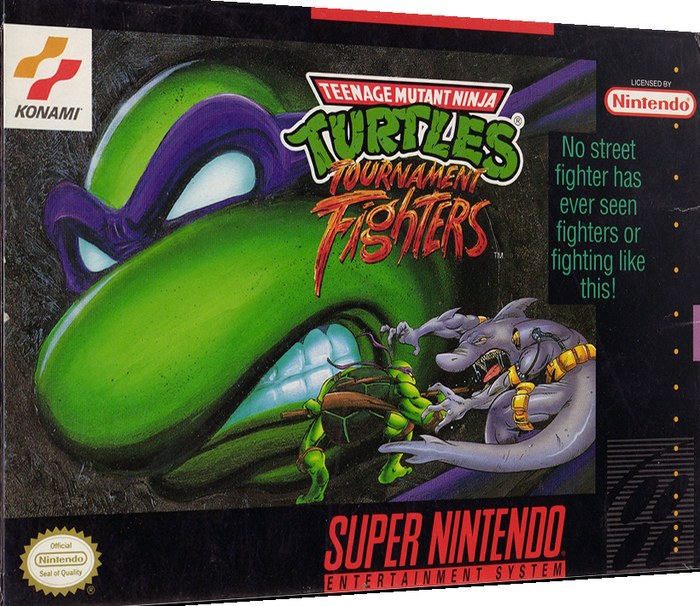
Tournament Fighters American Super NES box art, Donatello and Armaggon
America · Super NES · 1993
Donatello's face fills the American Super NES box, with Armaggon the mutant shark lunging at a much smaller turtle below. The tagline promises: "No street fighter has ever seen fighters or fighting like this!"
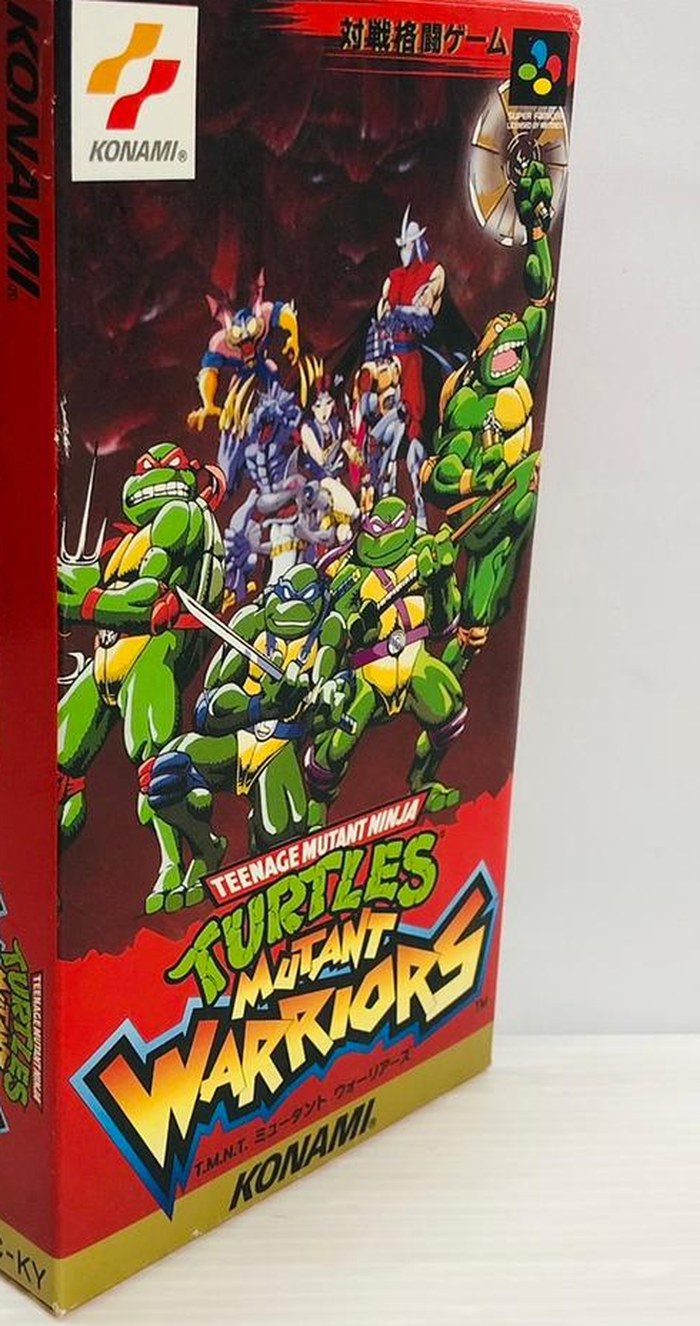
Tournament Fighters Japanese Super Famicom box art as Mutant Warriors
Japan · Super Famicom · 1993
In Japan the Super NES game is Mutant Warriors, and its box crowds all four turtles and the whole roster onto one red cover. A different title for what was already a different game from its siblings.

HOW IT WAS MADE

One brief, three games
The Super NES game
Konami's Super NES version is the closest to Street Fighter II: a four button scheme of weak and strong punches and kicks, a Mutagen meter that fills as you hit opponents and pays out in an ultimate attack, ten playable fighters plus two bosses, and a story mode in which Karai's Foot Clan has taken April O'Neil and Splinter. Its original fighter, Aska, was created for the game by Takemasa Miyoshi; she began as Mitsu from the third Turtles film and was renamed after that film's poor reception.
The Genesis game
The Genesis version is a darker, stranger game: eight playable fighters including April O'Neil as a combatant, Casey Jones, Ray Fillet and the original beetle fighter Sisyphus; a plot that runs through Dimension X against clones, ending at a Triceraton, Krang's android and Karai; breakable scenery; and desperation attacks usable only when your life gauge flashes red. Miki Higashino composed its music. It runs on the three button pad, with two attack buttons, strength set by holding toward the opponent, and the third button given to taunting.
The NES game
The NES version, built for a machine a generation older, has seven fighters: the four turtles, Casey Jones, Hothead the dragon warrior, and Shredder himself as the final opponent of a story that begins as a contest among the turtles. A flying monitor bearing Splinter's face crosses the arena dropping a fireball power up for whoever reaches it first.

THE RELEASE

December 1993, and one late arrival
Side by side
The Super NES and Genesis versions were released in Japan on December 3, 1993, and in North America and Europe the same month. Each version's cover starred a different turtle facing an opponent from that version: Leonardo for the Super NES, Raphael for the Genesis, Donatello for the NES. Michelangelo, with no fourth version to front, was left out.
The last Konami NES game
The NES version arrived in North America in February 1994. It was the final game Konami released for the NES in North America and the PAL region, and one of the few fighting games the 8 bit machine ever got during the fighting game boom. It was never released in Japan.
Renamed at home
In Japan the Super NES version was renamed Teenage Mutant Ninja Turtles: Mutant Warriors, with small differences inside: Aska's outfit and win animation differ, and the turtles' voices and icons were changed.

HOW IT WAS RECEIVED

The Super NES game took the crown
Electronic Gaming Monthly · Super NES
EGM's four reviewers scored the Super NES version 9, 8, 9 and 9 of 10, called it "a real surprise," and wrote that it was "the perfect blend of elements from Street Fighter II and Mortal Kombat," with one reviewer declaring that in some ways it was even better than Street Fighter II. It topped the United Kingdom Super NES chart in January 1994.
GamePro · Super NES
GamePro rated the Super NES version 4.5 of 5 for graphics, 4.5 for sound, and a full 5.0 for both control and fun factor. DieHard GameFan's panel scored it 369 of 400, against 248 of 400 for the Genesis version.
The dissent · Genesis
The Genesis version drew the era's shrug. EGM found few moves and unappealing fighters under a darker look, and Mega magazine called it "an uninspired beat em up that's borrowed everything from Street Fighter 2 but the gameplay," faulting sluggish, unresponsive controls. The NES version scored a middling 7, 7, 7, 7 and 6 in EGM.

WHAT IT LEFT BEHIND

Three games, one shelf

The name outlived the confusion. In 2022 all three versions were re released together in Teenage Mutant Ninja Turtles: The Cowabunga Collection, the Super NES version gaining online play with rollback netcode, the Genesis version gaining playable bosses, and the NES version gaining fixes for its flicker and slowdown. Players could finally compare the three games side by side without three consoles.

Aska had her own afterlife: EGM ranked her fourth on its 1993 list of the Top Ten Fighting Women. And the Super NES game is still routinely called what its reviews said it was, the licensed fighter that stood next to Street Fighter II instead of underneath it. Why one title covers three different games at all is the question this shelf keeps.

Why are the three versions different games?
MORE FROM THE FIGHTING GAMES ARCHIVE →
One shelf of eighty-two in the Library. Browse them all →

THE FIRST WORD

New pages and new pieces, first.