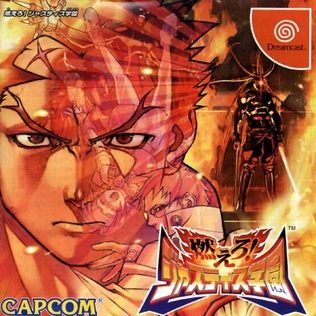
What Is New in Project Justice?
Project Justice (2000) is a sequel that changed the maths of its series: teams of three instead of two, a vigor meter rebuilt at five levels, the Party-Up triple attack, and the Team-Up cancel. This page lists what is actually new, system by system, without repeating the Rival Schools pages elsewhere on this shelf.
TEAMS OF THREE
The sequel's headline numberRival Schools fought in pairs. Project Justice fields teams of three, and the meter economy was rebuilt around them: the vigor gauge now caps at five levels, down from nine in the original. A standard Team-Up attack, two fighters combining, costs two levels. The new ceiling buys the new spectacle.
THE PARTY-UP
All three, all five bars, one school signaturePress any three attack buttons together with a full gauge and the whole team attacks at once: the Party-Up, costing all five vigor levels. It is not one shared animation. The Party-Up varies with the school of the character who starts it, so Taiyo High's triple assault is a different set piece from Gorin High's or Justice High's. Team selection is therefore also super move selection, a layer the two fighter original could not express.
THE TEAM-UP CANCEL
Being teamed up on is no longer a cutsceneThe sequel's cleverest addition is defensive. Caught inside an opponent's Team-Up, you may input your own Team-Up command, costing one vigor level: your counter sequence begins, and its first hit cancels the opponent's Team-Up entirely. The attacker keeps the initiative only if their sequence lands clean. Around the systems, the structure changed too: a Story Mode of per school campaigns with branching paths, and a Free Mode for mixed teams, with five new characters joining a returning cast missing only Raizo Imawano, now a Story Mode presence, and the guest Sakura.
What did not cross the Pacific is a separate story: what was cut outside Japan. The full record is on the history page.
THE GAME ON THE SHELF
Project Justice