
The History of Project Justice
Project Justice (arcade and Dreamcast, 2000), Moero! Justice Gakuen in Japan, is Capcom's sequel to Rival Schools, directed by Hideaki Itsuno. It grows the teams to three, adds the three person Party-Up and the Team-Up cancel, scored 80 on Metacritic with IGN at 8.8, and carries one of the era's clearest regional cuts: the Japanese Dreamcast version's board game character creator, removed from every Western release.
THE MAKING
One year later at the academiesProject Justice, Moero! Justice Gakuen in Japan, is Capcom's sequel to Rival Schools (1997), whose pages stand earlier on this shelf. Directed by Hideaki Itsuno and produced by Yoshihiro Sudo and Koji Nakajima, it runs on the NAOMI board and picks the story up one year on: the Imawano family is under attack by the Reverse Society, a doppelganger wearing Batsu's face is disgracing Taiyo High, and the schools march again. The plot is told per school this time, in a Story Mode of school specific campaigns with branching paths, beside a Free Mode that mixes any team.
WHAT CHANGED
Three fighters, and a way to cancel being teamed up onThe headline change is arithmetic: teams grow from two to three. Around that, Capcom built the Party-Up, a three person assault that varies with the school of whoever starts it, and a defensive novelty with no real equivalent elsewhere, the Team-Up cancel: caught in an opponent's team attack, you can spend meter to fire your own Team-Up into it, and the first hit cancels theirs. What is new, system by system, is laid out on this shelf at what is new in Project Justice.
Nearly the whole cast returns: every playable fighter from Rival Schools except Raizo Imawano, who appears in Story Mode as a non playable character, and the guest Sakura Kasugano. Five new characters join them, alongside alternate versions of existing fighters.
THE RELEASE
Arcade and Dreamcast in the same monthJapan got the game twice in December 2000: the arcade version, and the Dreamcast version on December 17, 2000, the NAOMI board and the home machine sharing their architecture as usual. Europe followed on April 13, 2001 and North America on May 16, 2001. Game Machine ranked it the most successful dedicated arcade game of January 2001.
One feature did not make the trip west. The Japanese Dreamcast version carries a character creation mode packaged as a board game, and the non Japanese versions cut it, a cut specific to this game and documented on this shelf: what was cut outside Japan. The arcade version returned in 2025 inside Capcom Fighting Collection 2; no sequel has ever been made.
THE COVERS
Japan and America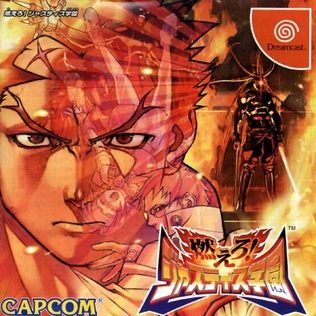
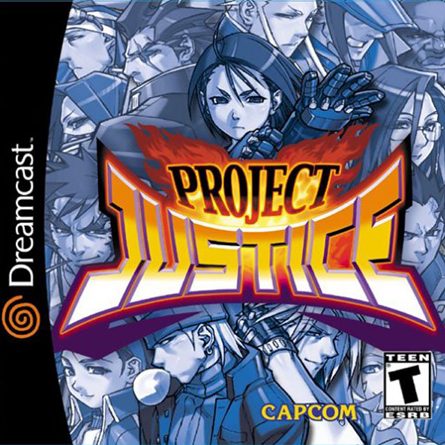
No two boxes on this shelf disagree more politely. Japan's cover is one face, Batsu burning with determination, the Moero! Justice Gakuen title doing the talking. America's is a class photograph, the ensemble in blue. A team game of three, sold as a solo portrait in one country and a group shot in the other. The Japanese cover shown here is a small scan, the best genuine file found; it is flagged for a larger swap in when one surfaces.
THE RECEPTION
80 on Metacritic, and a rental from the dissentThe Dreamcast version settled at 80 on Metacritic, with IGN at 8.8, EGM at 8.83, Famitsu at 33 of 40, and GamePro praising it across the board in its early review. GameSpot was cooler at 7.5 and Game Informer at 7. The dissent worth quoting is Next Generation's three stars, Chet Barber advising: "Unless you're hard-up for a new fighter, you may want to rent it". A good game arriving late in a crowded genre, on a console in its final year: the reviews and the calendar are both in that sentence.