
From the Library: covers, censuses, and editions, documented. Browse the Library →
SOJ Lupin III · The Artist
← Back to the Library

Who is Monkey Punch?

Kazuhiko Katō, a pen name he never liked, and a thief he could never put down.

Monkey Punch was the pen name of Kazuhiko Katō, born May 26, 1937 in Hamanaka, Hokkaidō, and raised on drawing: his strips ran in the school newspaper in junior high. He moved to Tokyo, studied electronics at technical school, drew dōjinshi, assisted Naoki Tsuji on Tiger Mask, and was recruited by Futabasha. His professional debut came in 1965 with Playboy School, under the name Eiji Gamuta.

The pen name was his editor’s idea, and Katō disliked it. He accepted because the new series, Lupin III, was supposed to run three months. It ran, in one form or another, for the rest of his life. He became a professor of manga and animation at Otemae University in 2005, lectured at the Smithsonian’s Freer Gallery in 2007, and died of pneumonia on April 11, 2019, aged 81.
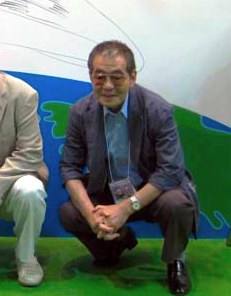
Monkey Punch (Kazuhiko Kato), photographed in 2009
MONKEY PUNCHKazuhiko Kato, who drew as Monkey Punch, photographed in 2009. He drew Lupin for over fifty years. (Photo: Wikimedia Commons.)

THE MAKER

1937 to 2019
The brother question
For years reference books said “Monkey Punch” was Katō and his younger brother Teruhiko together. In a 2017 interview the brothers corrected the record: Teruhiko was the assistant; the creative work was Kazuhiko’s alone.
The director’s chair
Monkey Punch directed one Lupin film himself: Dead or Alive (1996), the sixth animated feature, and contributed to the writing of the 2014 live-action film.
Honours
Inkpot Award, 1981; a special Tokyo Anime Award in 2015; judge for the Japanese Foreign Ministry’s International Manga Award in 2008.

THE HAND

How the art got its look
Tezuka lit the fuse
Monkey Punch said Osamu Tezuka was the reason he wanted to become a manga artist at all; the outlaw energy came from elsewhere.
Drucker taught the line
He acknowledged Mad magazine artist Mort Drucker as a direct influence: the rubbery faces, the crowd scenes, the sense that any panel might detonate into a gag.
Outlaws only
His parallel series of the Lupin years was Pinky Punky, another outlaw book. “I enjoy puzzles and mysteries,” he said, citing Columbo, Agatha Christie, Hitchcock, and The Three Musketeers.
The Mad magazine lineage →
The History of Lupin the Third →
MORE FROM THE LUPIN III ARCHIVE →
One shelf of the Library. Browse them all →

THE FIRST WORD

New pages and new pieces, first.