
Why did Battle Network reimagine Mega Man as a card RPG?
Mega Man Battle Network did not begin as a Mega Man game idea at all, and its developers have told the story on record. In a 15th anniversary interview with Inside Games, scenario writer Masakazu Eguchi, programmer Kouetsu Matsuda, and artist Hayato Kaji described how the Game Boy Advance project started as something else entirely, and how three currents of the year 2000, collectible card games, Pokemon, and the network society, rebuilt it into the card driven RPG that launched with the handheld in Japan on March 21, 2001.
FIRST, A HORROR GAME
Fun while your heart poundsEguchi: the team's first game was a horror game. Asked what they should make for the GBA, the team designed around a wearable device linked to the player's heartbeat, on the theme of "having fun while your heart pounds". Matsuda went to Expoland's haunted house for research. The mechanics, by the team's own account, became too difficult to handle, and the horror project died. What replaced it began from the market and the moment: "card games gained popularity around that time. We wanted to reap the trend while upholding Capcom's pride."
THE THREE CURRENTS
Cards, Pokemon, and the networkFirst, the cards: the system was conceived as the card game only Capcom could make, a mix of Mega Man's action and a card game the team called Data Action, in which the cards became data, Battle Chips, and fighting with them was the Mega Man character. Second, Pokemon: Battle Network was developed amid the success of Nintendo's portable RPG, and director Masahiro Yasuma recalled the difficulty of blending action attributes with "the kind of fun you get from a Pokemon game", with no effective precursor to copy. Producer Keiji Inafune stated the team aimed at younger gamers specifically, with a setting resembling the real world and a model mixing traditional action and RPG elements.
Third, the world itself. Eguchi situated the design in its moment: Windows 95 had come out, Y2K had not happened, and the worldview had become one of computer networks. The worldview and the system locked together: a network society outside, a card deck of data inside. One more design rule kept the action identity alive for the new audience, in Matsuda's words: "Let's make a game where a kid who's not great at the action can rely on strategy instead and still win." Hence a Mega Man with no jumping at all, as Eguchi put it, an action game rebuilt so the deck, not the thumb, decides.
THE TWO BOXES
The deck, drawn for childrenRockman EXE / Mega Man Battle Network
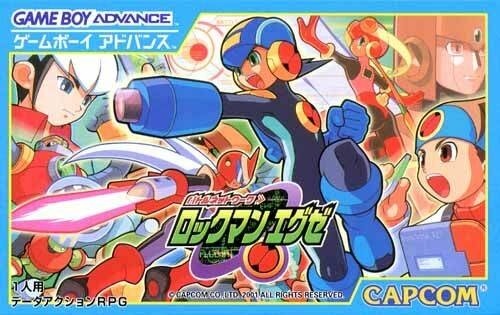
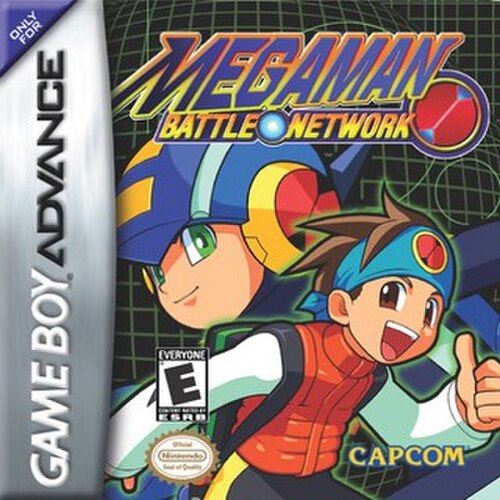
The card RPG was also a drawing decision: a hero a child could copy into a notebook was a hero a child would carry into the link cable battles.