
Why is Kirby white on the first American box?
Sakurai, Kirby's creator, always intended Kirby to be pink. The concept art shows pink, and the Japanese box for Kirby's Dream Land (1992) prints pink. The game itself could not settle the question for anyone watching a screen: the original Game Boy is monochrome, four shades of gray-green, so in play Kirby was simply the light blob against darker scenery.
Shigeru Miyamoto, seeing the same gray sprite, assumed Kirby would be yellow, and has said he was surprised to learn the character was pink. Before Japan's pink was locked in as common knowledge across the company, the game crossed to Nintendo of America, which had to produce a box, a cartridge label, an instruction booklet, and a television commercial for a character whose official color it could not see. America chose white, the color of the sprite itself.
The two explanations on record differ, and this page keeps both rather than merging them. Sakurai's account is that the American team simply misinterpreted the Game Boy sprite. Satoru Iwata, Nintendo's president and a HAL veteran, speculated at GDC 2011 that white was chosen to make Kirby more marketable in the United States. No document settles which motive drove the art department; what is documented is the result, a full American packaging suite built around a white Kirby for a pink character.
THE TWO BOXES
Kirby's Dream Land, 1992Kirby's Dream Land
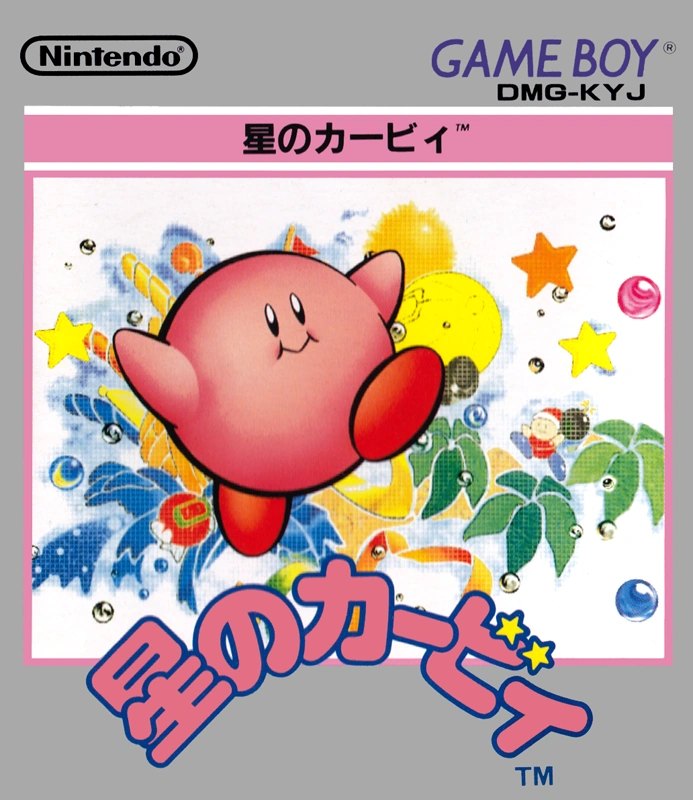
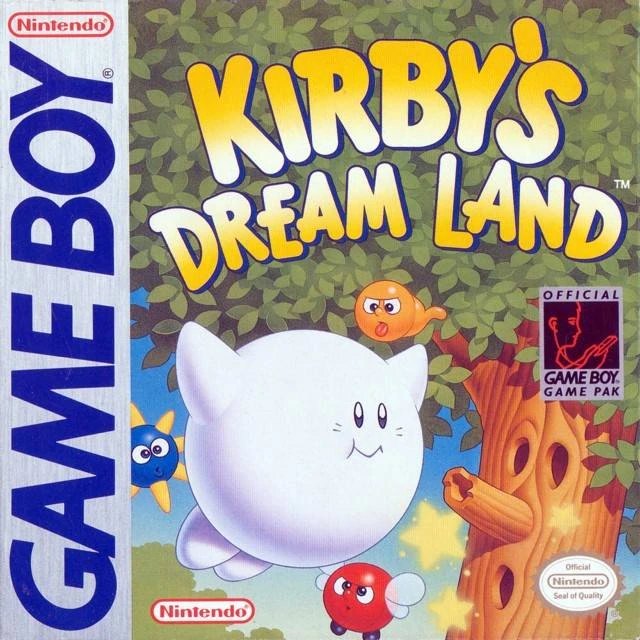
The confusion lasted exactly one game. Kirby's Adventure (1993) was the first Kirby in color, and Kirby was pink on every region's box from then on. The yellow Miyamoto imagined survived anyway: from Kirby's Dream Course (1994) onward, the second player's Kirby is yellow, nicknamed Keeby.
This page answers the color question only. The raised eyebrows that arrived a decade later, on Nightmare in Dream Land and after, are a separate marketing story, answered on the Library's Box Art page linked below.