
Why is the original Metal Gear a stealth game?
The man who made it told the story himself, on stage. In his Game Developers Conference keynote of 2009, Hideo Kojima said he was stationed in the division that worked on the MSX2 home computer, and that he was given a mission from his very first days at Konami to create a combat game for the MSX2. Rambo was a big hit, he noted, and his bosses wanted that kind of combat game on a popular platform.
The hardware said no. The MSX2 could place 32 sprites on a screen at once, and on a single horizontal line the ninth sprite simply would not display. Kojima demonstrated the point with a Konami shooter, its ships vanishing mid-flight, and told the room: this was not a bug, it was the hardware restriction. Layering sprites for color cut the count further. A player, two enemies, and two bullets nearly filled the screen. A firefight in the Rambo style was not a design problem. It was an impossible mission.
So he climbed around it, step by step, in his own telling. A combat game without fighting would not sell. A combat game about escaping, just running, was, in his word, uncool. A combat game about hiding could be revolutionary, and dressing it as infiltration made it heroic: slip into a military base, stay out of the enemy line of sight, and learn the rule that getting spotted brings everyone running. "Finally, I thought, an industry first: the stealth game genre was born."
What shipped on July 13, 1987, in Japan, with a European release the same year, was exactly that design: Solid Snake starts unarmed inside the fortified state of Outer Heaven, reads patrols by their straight lines of sight, and treats discovery as the disaster the whole game is built around. The MSX2 was never released in North America, so the original had no American release at all. It is now recognized, retrospectively, as the first mainstream stealth game.
THE GAME THAT SHIPPED
Outer Heaven, 1987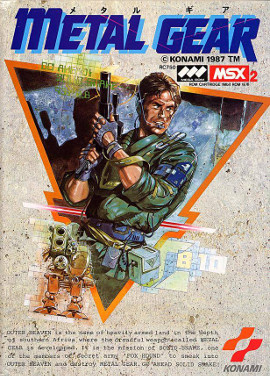
THE LADDER, IN HIS OWN TELLING
GDC 2009, summarizedTHE VERSION AMERICA GOT
A different game, honestly labeledMost American players met Metal Gear on the NES, and that version is a port with a documented history of its own. The Famicom version arrived in Japan on December 22, 1987, and the NES version in North America in June 1988, published by Konami's Ultra Games division. By Kojima's account, it was made by another Konami division in Tokyo, given the MSX2 source code without the original team's consent. Programmer Masahiro Ueno has said the port team had a three month deadline and was ordered to make the port as different from the MSX2 version as possible.
The differences are not cosmetic. The underwater infiltration opening became a jungle parachute drop. The basement floors became separate buildings reached through jungle mazes. And because of a hardware limit in the cartridge mapper used, the Metal Gear itself was replaced as the final boss by a supercomputer guarded by four soldiers. A game named Metal Gear, with no Metal Gear in it. Kojima has publicly disowned the port, and at GDC he joked that it was a "crap game, because I didn't participate." It still sold one million copies in the United States, which is why so many American collections hold the altered version as their original.