
From the Library: covers, censuses, and editions, documented. Browse the Library →
SOJ Killer Instinct Gold ยท Vintage Fighting Games
← Back to the Fighting Games Gallery

The History of Killer Instinct Gold

The arcade sequel, rebuilt for a cartridge, in a hurry.

Killer Instinct Gold is the Nintendo 64 version of Killer Instinct 2, Rare's 1996 arcade sequel, developed by Rare and published by Nintendo. It was planned as a launch title for the new console, missed that window, and reached North America on November 25, 1996, in time to become the fifth best selling video game of the 1996 Christmas season.

Gold keeps the arcade game's eleven characters, its combo system and its pre rendered stages, and loses its full motion video to the limits of the cartridge. What it gained, new team, tournament and training modes and an upgraded soundtrack, made it in several reviewers' judgment the better home package, even as its graphics were already being called dated against Tekken 2 and Virtua Fighter 2.

THE COVER, AND THE MISSING ONE

One box exists. One was never made.
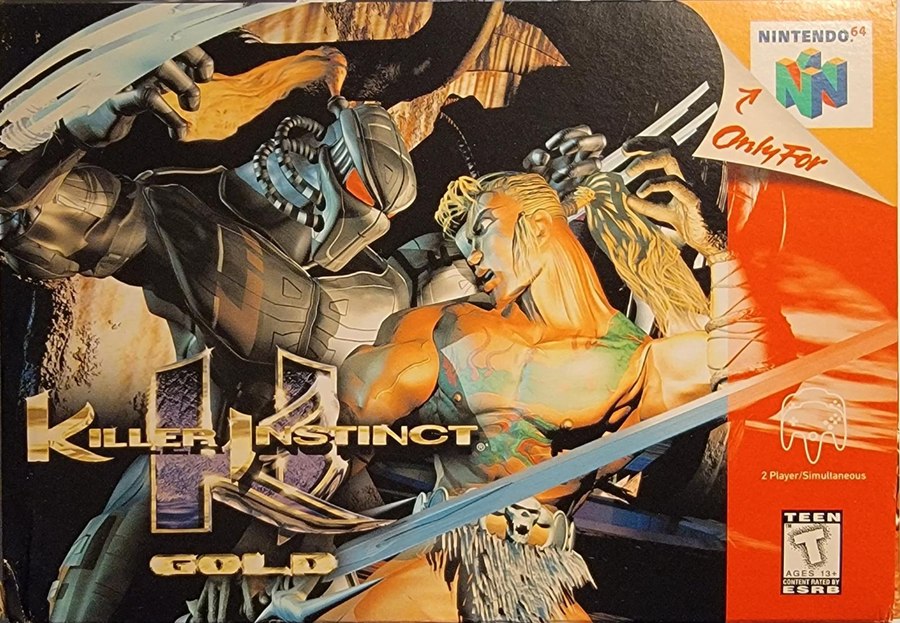

Killer Instinct Gold American Nintendo 64 box art, Fulgore and Tusk
United States
The American box: Fulgore and Tusk locked together behind the gold KI logo, with the red Nintendo 64 sidebar and the Teen rating.
SOJ gold owl
Japan
No Japanese box exists. Killer Instinct Gold was released in North America, Australia and the United Kingdom only, so this shelf holds the owl where the Japanese cover would stand.

HOW IT WAS MADE

A seven person team, split in two
The partnership
Rare was Nintendo's prominent second party developer, and the Killer Instinct series was produced as an exclusive partnership in response to the popularity of Mortal Kombat. Both series championed an aggressively fast pace over the patience of Street Fighter.
Split development
The Killer Instinct team divided itself between the arcade version and the Nintendo 64 release. The console team began work as soon as Rare received its Nintendo 64 development kit. Kevin Bayliss designed the characters; Chris Tilston built the game engine, with feedback from Nintendo's Ken Lobb.
Fitting the cartridge
Rare used compression technology to fit the arcade version onto the smaller Nintendo 64 cartridge, and optimized throughout: where the arcade used animation to fake a panning camera, the console version used static image files with less detail. Both versions share the same engine and roster.
The missed launch
Gold was originally scheduled to be one of the Nintendo 64's initial two launch titles. It missed its release window and arrived two months after the console, a delay that shaped its whole reception: it was judged as a 1996 game against 1996's fast moving competition.

THE RELEASE

North America first, Japan never
North America
November 25, 1996. Its soundtrack received a compact disc release, which was rare for Western video games in the 1990s.
Australia and the United Kingdom
Australia on May 9, 1997, and the United Kingdom on July 4, 1997. There was no Japanese release, which is why this game's gallery section holds one cover and one owl.
The game itself
Eleven characters: four new, including Maya, Tusk, Kim Wu and the boss Gargos, and seven returning. Fights run on a 2D plane against pre rendered 3D backgrounds, with six buttons, chained combos, combo breakers, and an announcer, Chris Sutherland, calling the big sequences.

The finishing moves deserve their own note, because they define the series' place between its rivals. Gold's finishers share similarities with Mortal Kombat's Fatalities, blood included, but are generally less graphic: finishing moves involving explicit dismemberment or decapitation are absent from the series.

HOW IT WAS RECEIVED

Named scores, with the argument kept
GameSpot 7.4/10
GameSpot named Gold the best entry in the series at the time and considered its graphics near perfect apart from the blur in its character animations, while preferring it clearly to the Nintendo 64's other fighter, Mortal Kombat Trilogy.
IGN 6.5/10
IGN felt the Killer Instinct 2 graphics appeared dated in Gold, with a cheesy 80s feel, and noticed fewer animation frames than the arcade, but preferred its crisp music and praised its sound, effects and camera work.
Game Informer 8.5/10 and EGM, split
Game Informer scored it 8.5 out of 10. Electronic Gaming Monthly's four reviewers split widely, at 8.5, 6, 7 and 6, a spread that captures the whole argument about the game in one review column.
Next Generation 2/5
The dissent at full strength: controls almost as awkward as on the Super NES, and ultimately not much fun. N64 Magazine, at 62 percent, gave Gold a lifespan of weeks rather than months, and agreed with Next Generation that Tekken 2 and Virtua Fighter 2 had outclassed it.

The shared criticism, from IGN, Computer and Video Games and others, was the combo system itself: an emphasis on memorized sequences that diminished improvisation and skill, forcing players to train before they could produce combos long enough to win. The training mode built to answer exactly that problem was, in turn, widely praised.

WHAT IT LEFT BEHIND

A long sleep, then two returns

Gold did not replicate the success of its Super NES predecessor, and IGN later reported that fans were upset by changes in the combo system and the absence of several well liked characters from the original game. After Gold, the series went dormant. Microsoft purchased Rare in 2002, and the series was revived for Xbox One in 2013.

Gold itself returned twice: in Rare Replay, the 2015 Xbox One retrospective compilation, where retrospective reviewers were unkind, Destructoid singling it out as the collection's worst title, and on Nintendo's Classics service in May 2025. GamesRadar had earlier ranked it the 35th best game on the Nintendo 64. Its reputation sits exactly there: a mid table N64 fixture whose arcade parent was a phenomenon, and whose compromises are a clean record of what a 1996 cartridge could and could not carry.

THE QUESTIONS

Asked of this game
More fighting games →
MORE FROM THE FIGHTING GAMES ARCHIVE →
One shelf of eighty-two in the Library. Browse them all →

THE FIRST WORD

New pages and new pieces, first.