
From the Library: covers, censuses, and editions, documented. Browse the Library →
SOJ Mortal Kombat II · Vintage Fighting Games
← Back to the Fighting Games Gallery

The History of Mortal Kombat II on Home Consoles

The sequel Nintendo let through the door it had barred a year before.

The first Mortal Kombat came home split in two: blood on the Genesis by code, sweat on the Super NES by policy. Its sequel arrived in arcades in November 1993 bigger in every way, and when the home versions launched on September 9, 1994, the split was gone. This page starts where that story ends: the reversal, the launch, and the reception. The first game's sweat and blood code have their own pages in this Library.

THE COVERS

One dragon, two statements
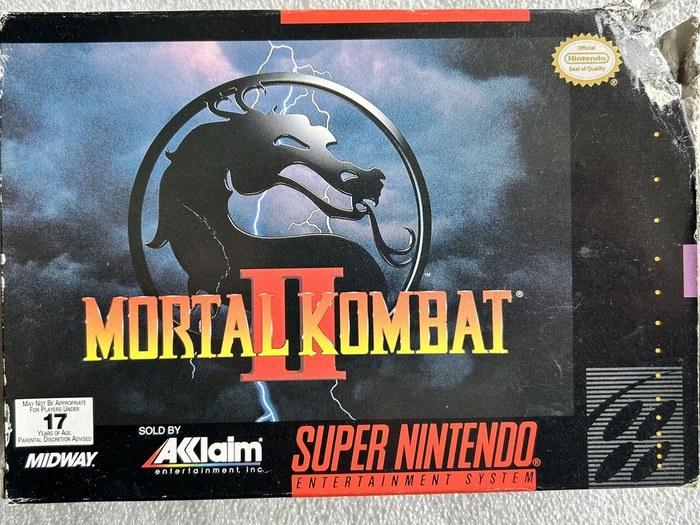
Mortal Kombat II American Super NES box art with under 17 warning label
America · Super NES · 1994
The American Super NES box. Read the white label at lower left: "May Not Be Appropriate For Players Under 17." In 1994 that warning was the story of the game, printed on the box itself.
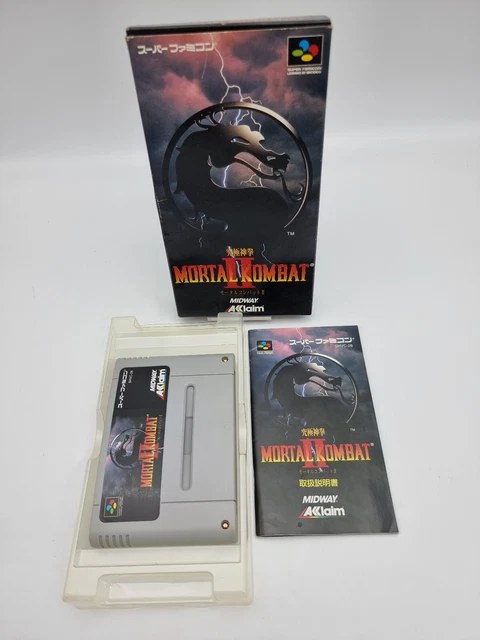
Mortal Kombat II Japanese Super Famicom box, cartridge and manual
Japan · Super Famicom · 1994
The Japanese edition, shown here as the complete package, box, cartridge and manual. In Japan the same game shipped with its blood recoloured green.

HOW IT WAS MADE

Two port houses, one reversal
Sculptured and Probe
As with the first game, Acclaim published the home versions. Sculptured Software built the Super NES version; Probe Software built the Genesis, Game Boy and Game Gear versions. The arcade original, by Ed Boon and John Tobias at Midway, had reached arcades in November 1993 with twelve fighters, multiple Fatalities per character, and two new finishers, Babalities and Friendships.
The reversal, built in
Due to the poor showing of the censored Super NES version of the first game, Nintendo decided to allow depictions of blood and Fatalities this time around. Because the industry rating system was not expected to be in effect until November 1994 at the earliest, the Super NES version carried no formal rating; a warning label on the box informed buyers about the mature content instead.
The creator's verdict
John Tobias favoured the Super NES version over the Genesis version, saying: "I would go so far as to say that the Super NES version is one of the best arcade to home conversions I have seen." The Japanese version, meanwhile, was censored in the other direction: green blood for every fighter, and Fatality sequences drained to black and white.

THE RELEASE

Mortal Friday, September 9, 1994
Four versions, one day
The Super NES, Genesis, Game Boy and Game Gear versions launched simultaneously on September 9, 1994, a date dubbed Mortal Friday, backed by a 10 million dollar global marketing campaign. More than 2.5 million copies were shipped for the launch, distributed to some 15,000 stores by 65 trucks and 11 jumbo jets.
Fifty million in a week
First week sales passed 50 million dollars in the United States, which Acclaim called the largest introduction of a video game in history, outgrossing the opening weeks of that season's film blockbusters, Forrest Gump, True Lies, The Mask and The Lion King. For a stretch it was the world's best selling video game, until Donkey Kong Country passed it that November.
The honest scoreboard
In the United States the Genesis version sold 1.78 million copies and the Super NES version 1.51 million. The gap from the first game had collapsed from five to one to nearly even, but it had not flipped. What had flipped was the policy, not yet the sales order.

HOW IT WAS RECEIVED

Near perfect, said the magazines
Electronic Gaming Monthly
EGM's four reviewers hailed the Super NES version as a "near perfect" translation of the arcade game, scoring it 9, 8, 8 and 8 of 10. The Genesis version scored 8, 7, 7 and 7.
Computer and Video Games
C+VG scored the Super NES version 96 percent and the Genesis version 97 percent, declaring the Super NES port "the most perfect coin op conversion ever" and Patterson writing of the Genesis conversion: "Everything is here, and I mean everything." Next Generation gave the Super NES version five stars.
The awards shelf
Game Players named it Best Genesis Fighting Game, Best Super NES Fighting Game and Best Overall Super NES Game of 1994. VideoGames named it Best Fighting Game of 1994 and second in Best Arcade to Home Translation. EGM gave it a drier honour: Bloodiest Game of 1994.

WHAT IT LEFT BEHIND

The M on the box

Ed Boon, looking back, said: "Once Mortal Kombat II came out, there was a rating system in place. We were an M rated game, and everybody knew the content that was in there, so it became almost a non issue." Tobias agreed that the team "were content with the M for mature on our packaging." The sequel that Nintendo would not have dared release a year earlier became the proof that the ratings box, not the censor, was the settlement.

The game itself kept its reputation: GameSpot later wrote that it "was so much better, as a sequel, than it had to be," and it is still routinely named the best in its series. Why Nintendo changed its mind, and what the game's strangest finishers were for, are the two questions this shelf keeps.

Why did Nintendo allow the blood?What were Friendships and Babalities for?
MORE FROM THE FIGHTING GAMES ARCHIVE →
One shelf of eighty-two in the Library. Browse them all →

THE FIRST WORD

New pages and new pieces, first.