
The History of Power Stone
Power Stone (arcade and Dreamcast, 1999) is Capcom's arena fighter: full 3D movement, weapons made of furniture, and a transformation earned by collecting three Power Stones. Producer Takeshi Tezuka built it, in his own words, to return fighting games to the masses. Critics adored it, Edge 9 of 10, Next Generation five stars, and it sold about 200,000 copies. Both halves of that sentence matter to its story.
THE MAKING
A Street Fighter layout thrown away, on purposePower Stone began life as a conventional side view fighting game in the Street Fighter mould, and was rebuilt halfway through development into something else: a fully 3D arena fighter, viewed from overhead, where fighters run anywhere, climb, and swing the furniture. The Guardian's 2019 retrospective, built on interviews with the game's makers, records that it was first intended for Matsushita's cancelled M2 console before Sega's NAOMI and Dreamcast became its home.
The intent is on record in the team's own 1999 words. Producer Takeshi Tezuka, interviewed in Dreamcast Magazine at release, said the so called 3D fighters of the day were really 2D games, and that Power Stone's ambition was a proper three dimensional game that would return fighting games to the masses, at a moment when the genre had narrowed to what he called maniac level experts. Director Hideaki Itsuno said the same thing to The Guardian twenty years later: the game was aimed at players other than the hardcore.
THE DESIGN
Three buttons, no block, three stonesThe control scheme was reached by subtraction. The team tried a six button layout and a two button layout before settling on three: punch, kick, jump. Most decisive of all, in Tezuka's own account, was removing the guard button entirely: no blocking, only movement, dodging, and the arena itself for defence. He called that removal the choice that most broke the game free from the fighting game mould.
The arenas are stocked with tables, chairs, rocks, and bombs, all usable as weapons. The prize objects are the Power Stones: collect three and your fighter transforms, the Power Change, gaining two super attacks, one long range and one close grab, until the power bar drains. Ten characters contest it, treasure hunters of a 19th century legend, from Edward Falcon to the unlockable boss Valgas.
THE RELEASE
A Dreamcast launch window fighterThe NAOMI arcade version arrived in February 1999. The Dreamcast version launched in Japan on February 25, 1999, reached North America on September 9, 1999 among the Dreamcast launch titles, and Europe on October 14, 1999, published there by Eidos. A television anime and a manga ran alongside it in 1999, and footballer Thierry Henry named it his favourite Dreamcast game during a 1999 promotion.
THE COVERS
Japan and America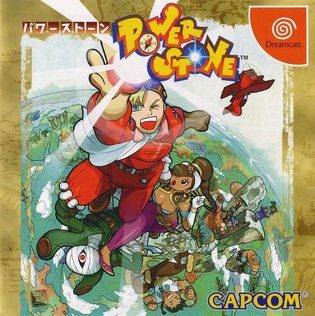
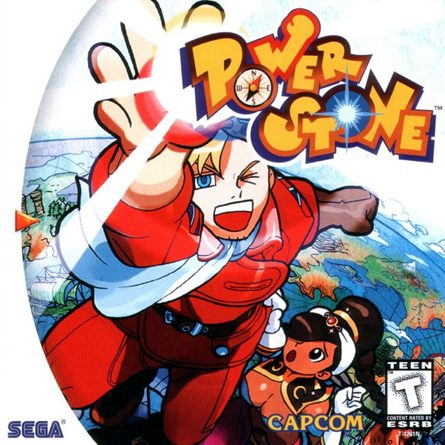
Both boxes use the same key painting. Japan frames the whole ensemble, gold bordered, the cast jostling behind Falcon. America zooms in until Falcon's hand nearly leaves the box. The Japanese cover shown here is a small scan, the best genuine file found; it is flagged for a larger swap in when one surfaces.
THE RECEPTION
A jewel in the crown, 200,000 copiesCritics were generous: Edge scored it 9 of 10 and called it "a jewel in Dreamcast's crown"; Next Generation gave five stars and Blake Fischer's verdict that "every Dreamcast owner should have this title"; IGN 8.7, Famitsu 34 of 40, GameRankings about 83 percent. The dissent was GameSpot at 7.6 and EGM at 7.5, and AllGame, while positive, wished aloud for a bigger cast and four players, the two wishes the sequel would grant.
The sales were not generous. The game sold about 200,000 copies, and the series has never appeared on Capcom's Platinum Titles list of million sellers. Power Stone 2 followed in 2000 with four player arenas, the pair were collected on PSP in 2006, and the original returned in Capcom Fighting Collection 2 in 2025. Why the design never became the template for the genre is the question on this shelf: the arena that stayed a side road. Tezuka, for the record, still gets asked for a new one, and told The Guardian he would love to make it.