
The History of Valkyrie Profile
Valkyrie Profile is a role playing game developed by tri-Ace and published by Enix for the PlayStation, released in Japan on December 22, 1999 and in North America on August 29, 2000. It was directed by Yoshiharu Gotanda, produced by Yoshinori Yamagishi, designed and written by Masaki Norimoto, drawn by Ko Yoshinari and Yoh Yoshinari, and scored by Motoi Sakuraba.
Lenneth, a recently awakened valkyrie serving Odin, travels Midgard collecting the souls of slain heroes. She trains them as einherjar, then decides if and when to send them to Valhalla to fight for the Aesir in the war against the Vanir and the coming of Ragnarok. Everything she does is spent from a fixed purse of time, and heaven keeps a grade on her. Both systems get their own pages in this archive.
HOW IT WAS MADE
tri-Ace, 1999The game began as a system before it was a story. In a 1999 developer interview, director Yoshiharu Gotanda said the first part that came to him was the gameplay loop itself: characters you raise on Earth, who you then send off to Valhalla to fight. At the start of development the fighting in Valhalla was the main event and the game was a strategy RPG, with more than 100 characters treated as units rather than people. Gotanda cut that version back because it demanded too much time and left no room to give each character a detailed personality. The backstory and plot were finished after the gameplay system.
Producer Yoshinori Yamagishi told Famitsu in October 1999 that work had started before Star Ocean: The Second Story was released, and that the side scrolling presentation was a deliberate answer to the PlayStation's limits: the best way to portray a beautiful environment on the hardware, a way to use large characters with better acting, and a quiet pun on the title, since a profile is also a side view. The dungeons play like a platform game, with Lenneth jumping, sliding, swinging her sword, and shooting ice crystals that freeze enemies and build temporary steps.
The cast is the structure. There are 24 playable characters, and most einherjar development happens in the scenes of their deaths, which the game treats as small dramas of their own. Their stories continue in Valhalla in dialogue with the gods, which is why sending a favorite character away actually costs the player something.
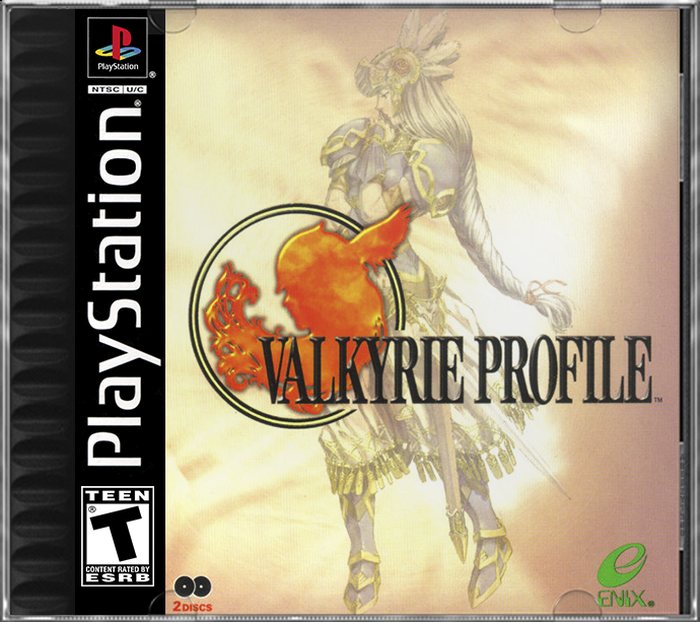
THE TWO COVERS
Same painting, two crops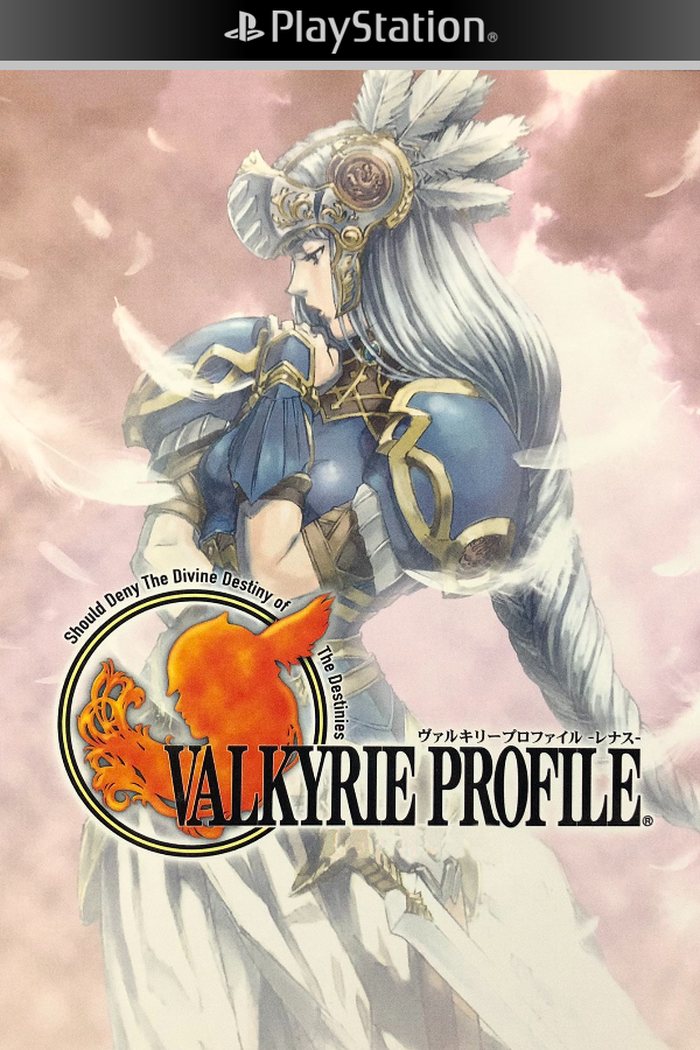
THE CLOCK AND THE GRADE
Eight chapters, then the Sacred PhaseThe game is divided into eight chapters, and each chapter is divided into periods: 16 on Easy, 24 on Normal, and 28 on Hard. Visiting towns and dungeons and recruiting einherjar all spend periods, so every chapter is a budget. When the periods run out, the Sacred Phase begins: Lenneth returns to Asgard and Freya reports on the war, on the fate of the einherjar already sent, and on Lenneth's standing.
Each chapter asks Lenneth to send at least one einherjar to Valhalla, two at most, matched against requirements set at the chapter's start. Sent einherjar are gone from the party unless they survive to the endgame. Keeping dungeon artifacts for yourself instead of offering them up, or failing to send suitable heroes, drags Lenneth's Evaluation down, and an Evaluation of 0 triggers the worst of the game's three endings. The full mechanics, and the endings themselves, are documented on their own pages below.
THE RELEASE
Japan 1999, America 2000The English release was not a straight port. The documented record lists several improvements made for it: more cinematics, the ability to adjust the armor of all characters rather than only the active party, and a notification when Lenneth's weapon changes between sword and bow. Some editing occurred in translation, though visible blood, drinking, and sexual comments remain; the mercenary Badrach lost his cigarette, while the animation of him smoking after a won battle remains, minus the cigarette. The separate page on the two versions gathers the full comparison.
HOW IT WAS RECEIVED
The scoresTHE SALES
Documented figuresThe game sold over 310,000 copies in Japan by the end of 1999, its first days on sale. By September 2005, tri-Ace's own sales record put the PlayStation version at over 709,000 copies worldwide, of which 636,000 were sold in Japan alone. A hit at home, then, and a much smaller presence abroad: the shape of this series' whole commercial life, visible already in its first game.
WHAT IT LEFT BEHIND
The series it startedValkyrie Profile became a series: a PlayStation 2 prequel, Valkyrie Profile 2: Silmeria, and a Nintendo DS prequel, Covenant of the Plume, with the original itself carried to the PSP as Valkyrie Profile: Lenneth. Its postgame dungeon, the Seraphic Gate, was a deliberate break with the setting: Gotanda described it as a bonus for players who had already cleared the game, a place for pure combat against the strongest enemies. The whole series had shipped 2.2 million copies by 2016.